Blog
In response to “Why You Can’t ‘Just Say No’ to Data Centers” – a commentary by Clean Air’s Intern Ethan Paley
There is no ban more legally defensible than an implicit one.
Since Euclid v. Ambler, municipalities across the United States have used zoning to implicitly prohibit “undesirable” housing (generally multifamily housing suited for low-income residents). Planners know this well: Exclusionary zoning isn’t a new concept, nor is it an old one.
The APA’s recent article, Why You Can’t ‘Just Say No’ to Data Centers, suggests that municipal planners are legally limited in their ability to halt data center development. In the most technical sense possible, they’re not wrong: Courts have historically sided against openly discriminatory practices, like the withholding of utilities from specific customers, or failing to consider regional housing needs.
However, Why You Can’t ‘Just Say No’ to Data Centers fails to address that exclusionary zoning never stopped: Planners aren’t limited in their ability to discriminate, as long as they play their cards correctly. Yes, federal law prohibits discrimination on the basis of race, sex, national origin, and disability, but income isn’t a protected class. Courts can require planners to make it possible to build multifamily housing in suburbs, but they have little power over whether it’s cheap and easy to do.
Planners and bureaucrats have always abused this fact: While towns can’t outright ban multifamily housing, the vast majority of suburbs have segregated dense housing to industrial zones, implemented lot-size requirements, limited floor-to-area ratios, imposed building height maximums, and even required ground-floor retail in multifamily developments. None of these rules explicitly ban multifamily housing, but they make multifamily housing far less desirable and far more expensive for developers and residents alike.
Why You Can’t ‘Just Say No’ to Data Centers concludes by reassuring planners that the “limitations” on their abilities, “while frustrating,” are present because our legal system is “preventing discrimination” and “equitably apportioning the costs of growth.” One only needs to step outside to see that this has never been the case. The suburbs are still overwhelmingly white and wealthy, and poverty is still concentrated in our inner cities.
I agree that planners can’t “just” say no to data centers. But, every planner knows that they’ve never needed to “say” no to a land use.
Why You Can’t ‘Just Say No’ to Data Centers draws a parallel between inclusive housing and data center development, and while its writer framed it differently, this comparison couldn’t be more accurate. Planners have implemented rules to perpetuate the status quo of segregation by making multifamily housing implicitly infeasible, and with those same means, planners can inflate costs and make data center development infeasible.
The segregationists of our past endowed planners with the ultimate tool of discretion, and while that tool has been abused for generations, it would be irresponsible to pretend it’s no longer in our hands. Zoning has always been used to inflate costs and prevent projects; now it’s up to you to choose which projects need preventing.
Please join our Erie-Niagara Data Center Campaign Team to help us design local zoning and other ordinances which make sense for each community, whether that be a ban or a strict regulatory approach. The Town of Tonawanda just hired a new Planner, and we’re looking forward to working with her to develop an ordinance there in 2027.
October-November 2026 Monthly Updates: Election Day – Tomorrow Tuesday November 3, 6am-9pm
Click here to subscribe to our monthly e-newsletter, and view this month’s edition by clicking the “More” link just below.
September-October 2026 Monthly Updates: Brisk and Bustling October Ahead!
Click here to subscribe to our monthly e-newsletter, and view this month’s edition by clicking the “More” link just below.
August-September 2026 Monthly Updates: Labor is entitled to all it creates (Happy Labor Day!)
Click here to subscribe to our monthly e-newsletter, and view this month’s edition by clicking the “More” link just below.
NYS Senator Kristen Gonzalez Kicks Off Statewide “NYS Fights AI Data Centers” with a Clean Air-led Tour of Erie-Niagara Data Center Projects
Erie and Niagara County began grappling with hyperscale data centers a full decade ago, starting with cryptomining operations drawn here by the cheap energy and water resources, local elected officials eager for any new industrial developments, a lack of local regulations, and the possibility of building projects at vacant industrial facilities.
In June, the NYS Assembly and Senate passed the Responsible Data Centers Development Act (S10642/A11560), a bill which would initiate a 1-year moratorium on data center development projects larger than 20MW, and which is tied to a number of regulatory studies and action, including some basic baseline standards, like a statewide comprehensive Environmental Impact Statement study, prevailing wage and “Buy American” requirements, requirements for on-site renewable power, and establishment of a separate water and energy classes for data center projects to prevent costs being passed onto other ratepayers.
In response to hundreds of in-person visits, phone calls, and emails from residents all throughout our region, many WNY representatives voted for this bill, namely Senators Baskin and Zellner, Majority Leader Peoples-Stokes, and Assemblymembers Conrad, McMahon and Rivera.
Governor Hochul followed with an Executive Order which carried forward some of the bill’s provisions, including a 1-year moratorium on data center projects larger than 50MW. While we at the Clean Air Coalition of WNY applaud the Governor’s bold action, the first of its kind in the nation which immediately put a pause on the most concerning private sector hyperscale data center projects across the state, we still urge her to sign the RDCDA, as it is wider in scope.
Given all this, when State Senator Kristen Gonzalez, the Chair of the Senate Internet and Technology Committee, reached out to let us know that she was kicking off a statewide NYS Fights AI Data Centers Tour with a stop in Buffalo, we jumped at the opportunity to give her a full court tour.
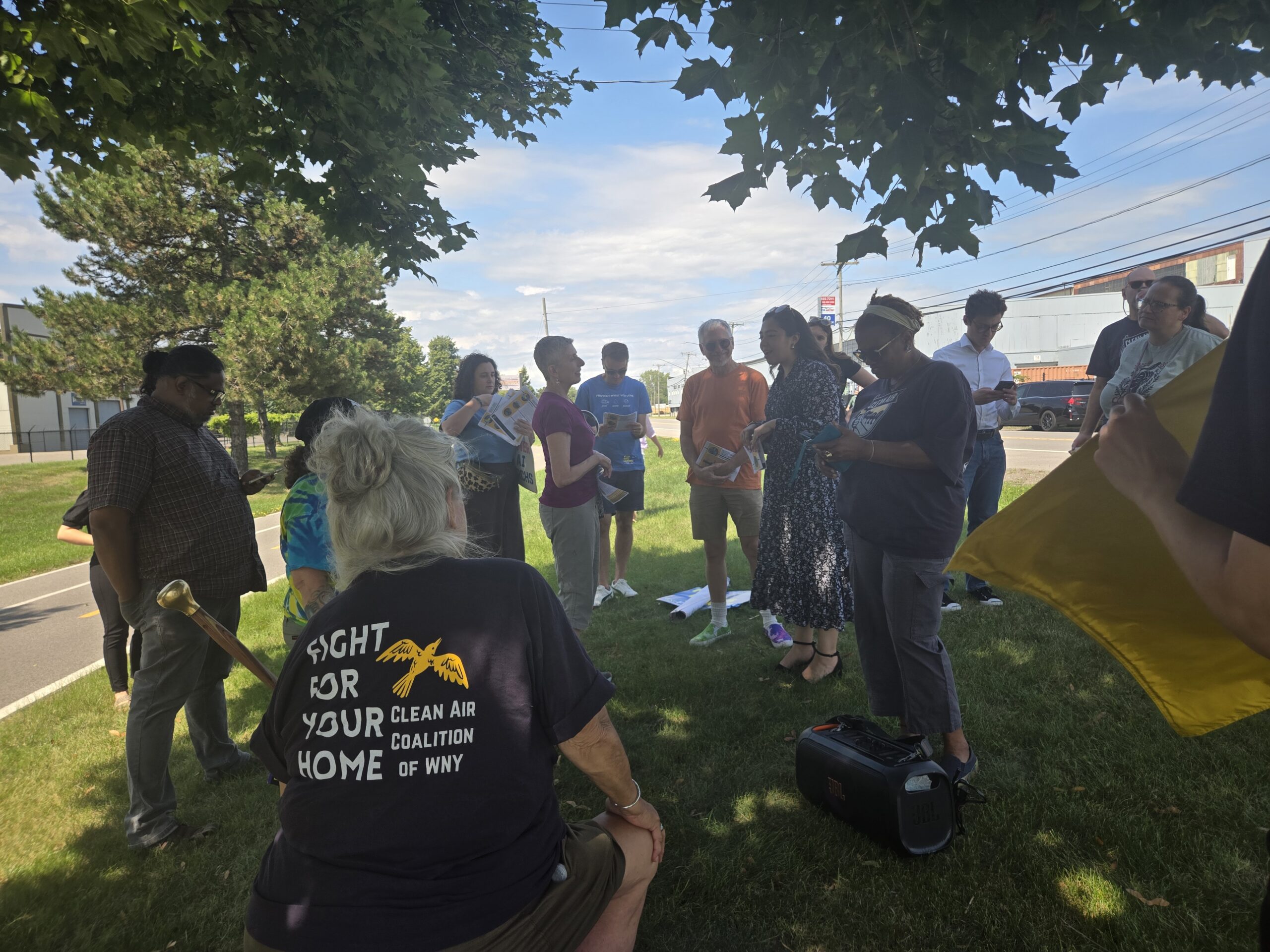
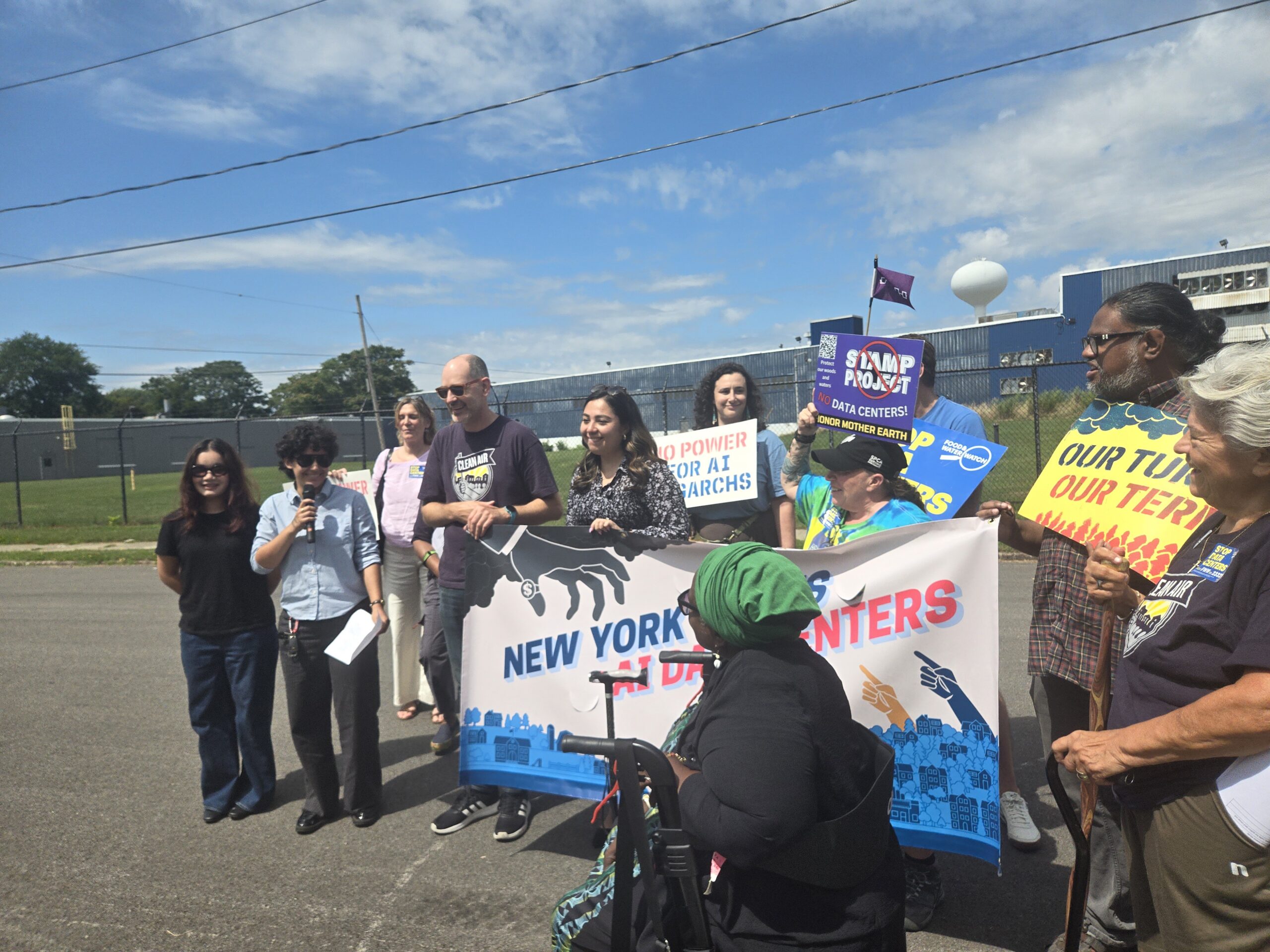
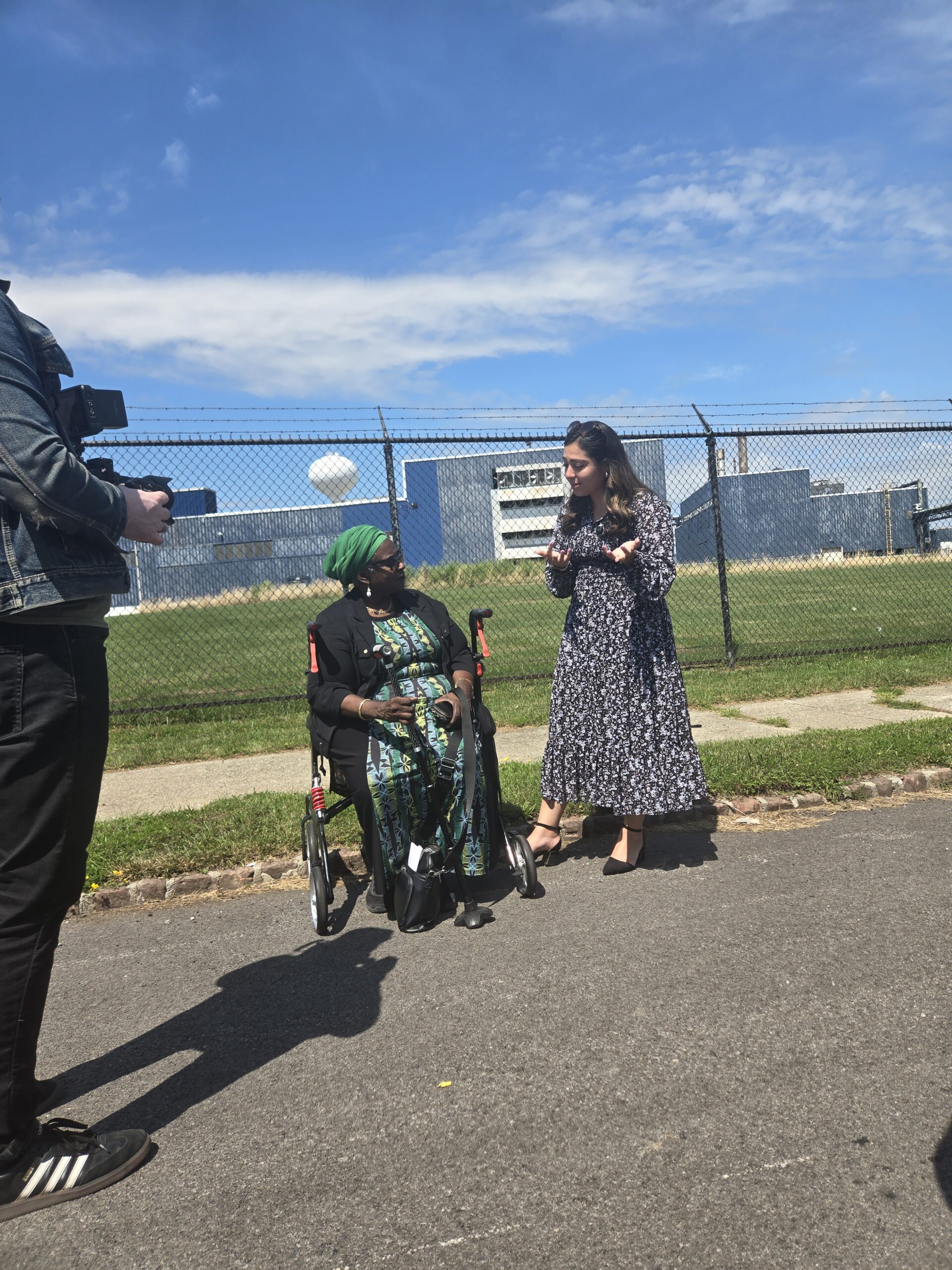
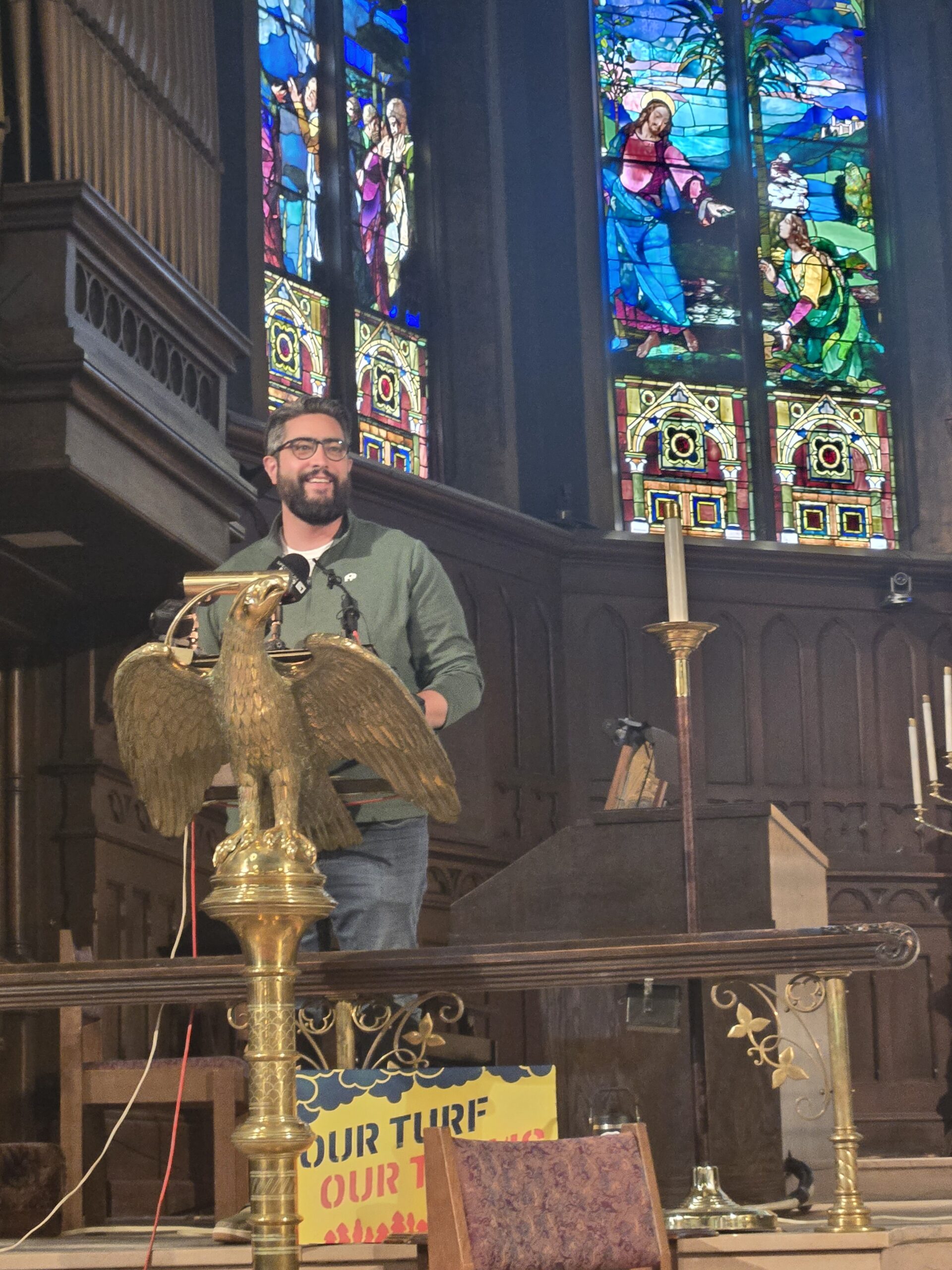
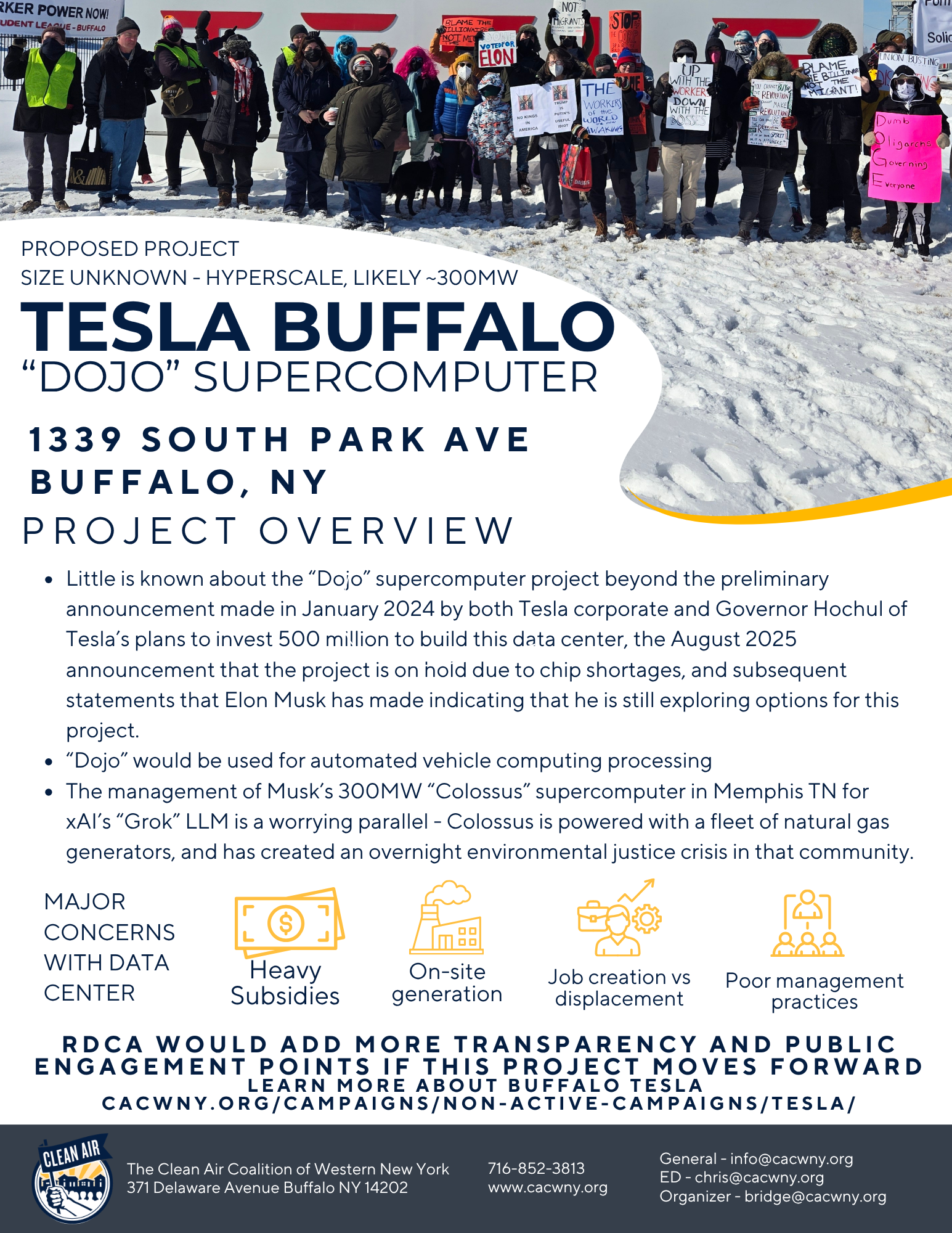
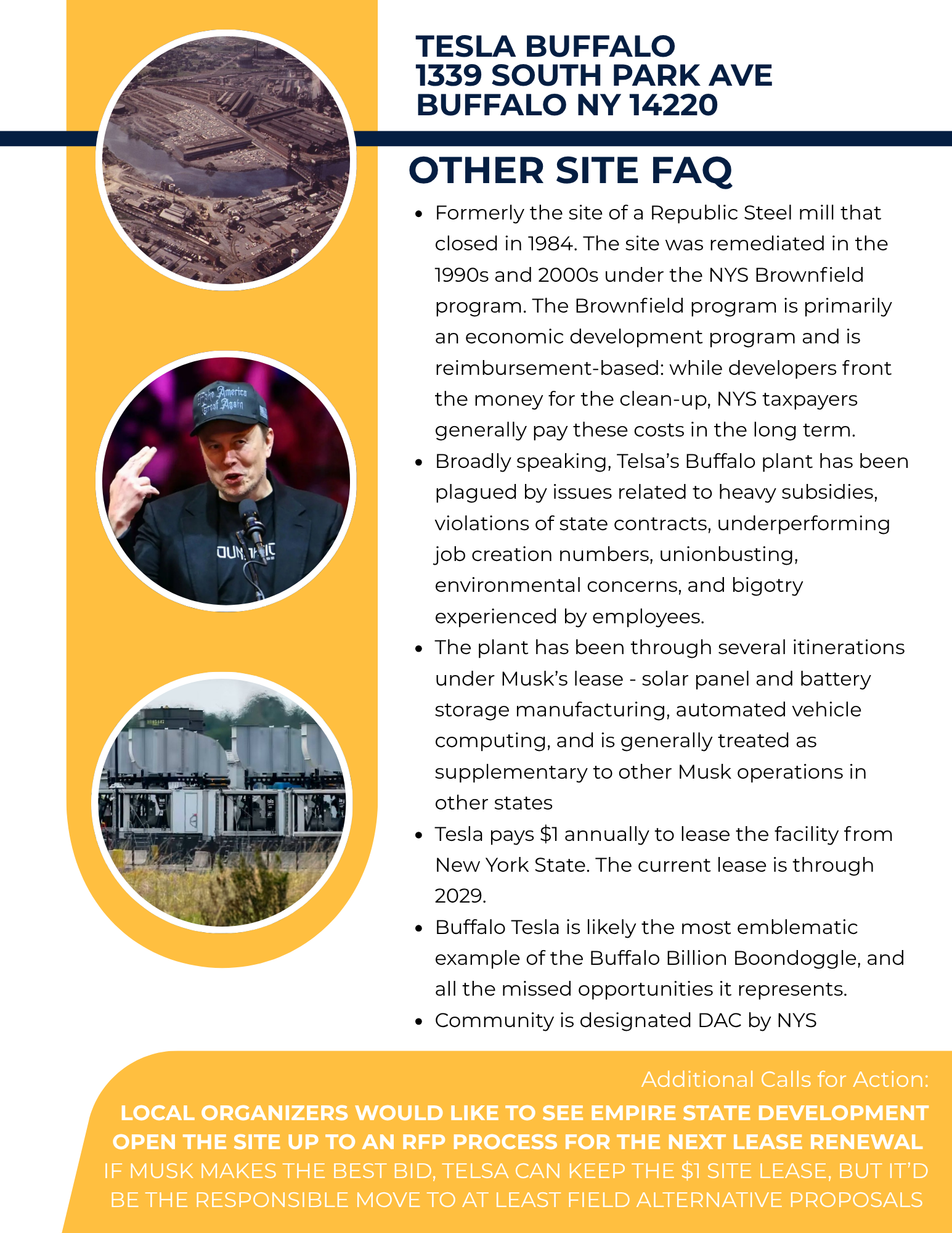
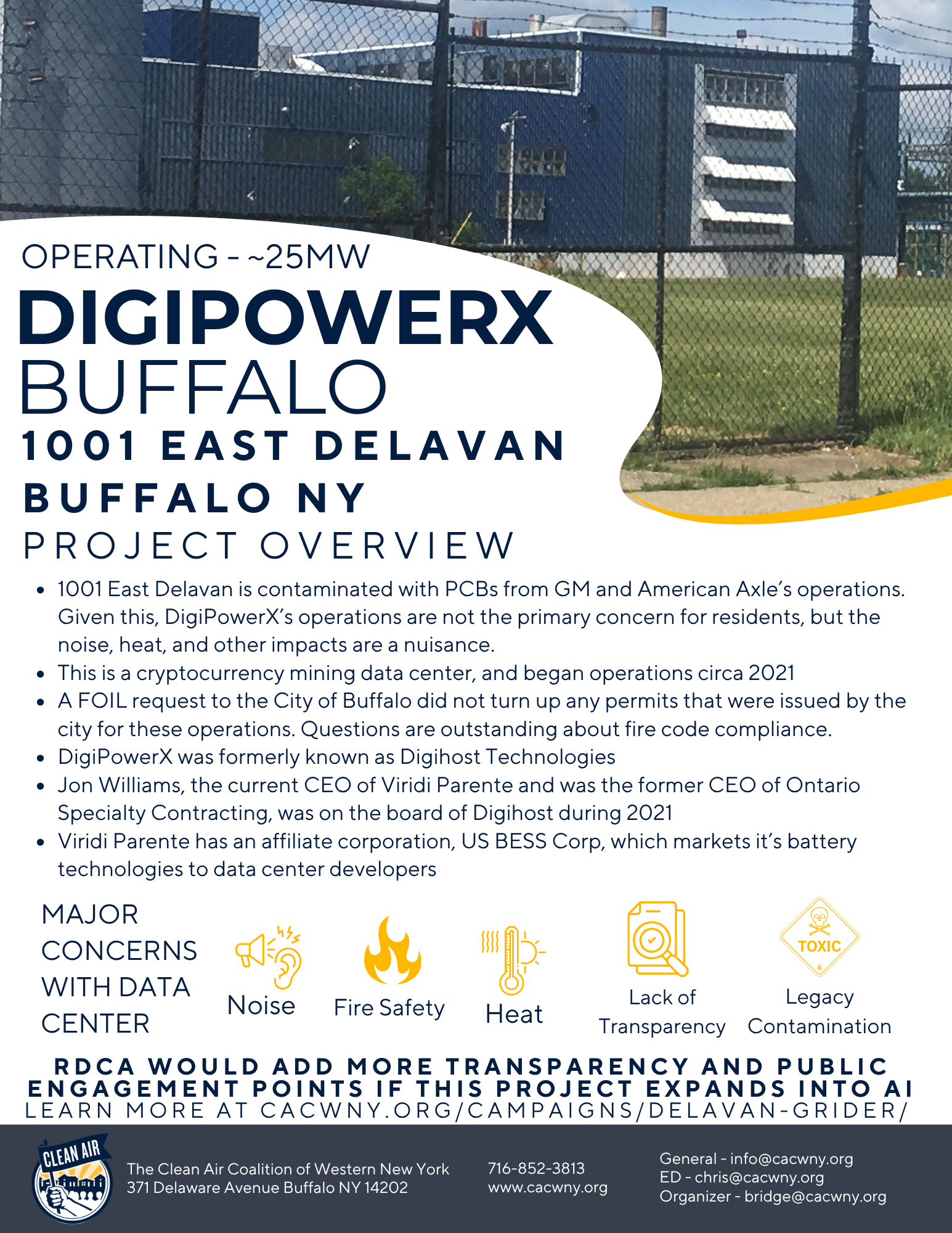
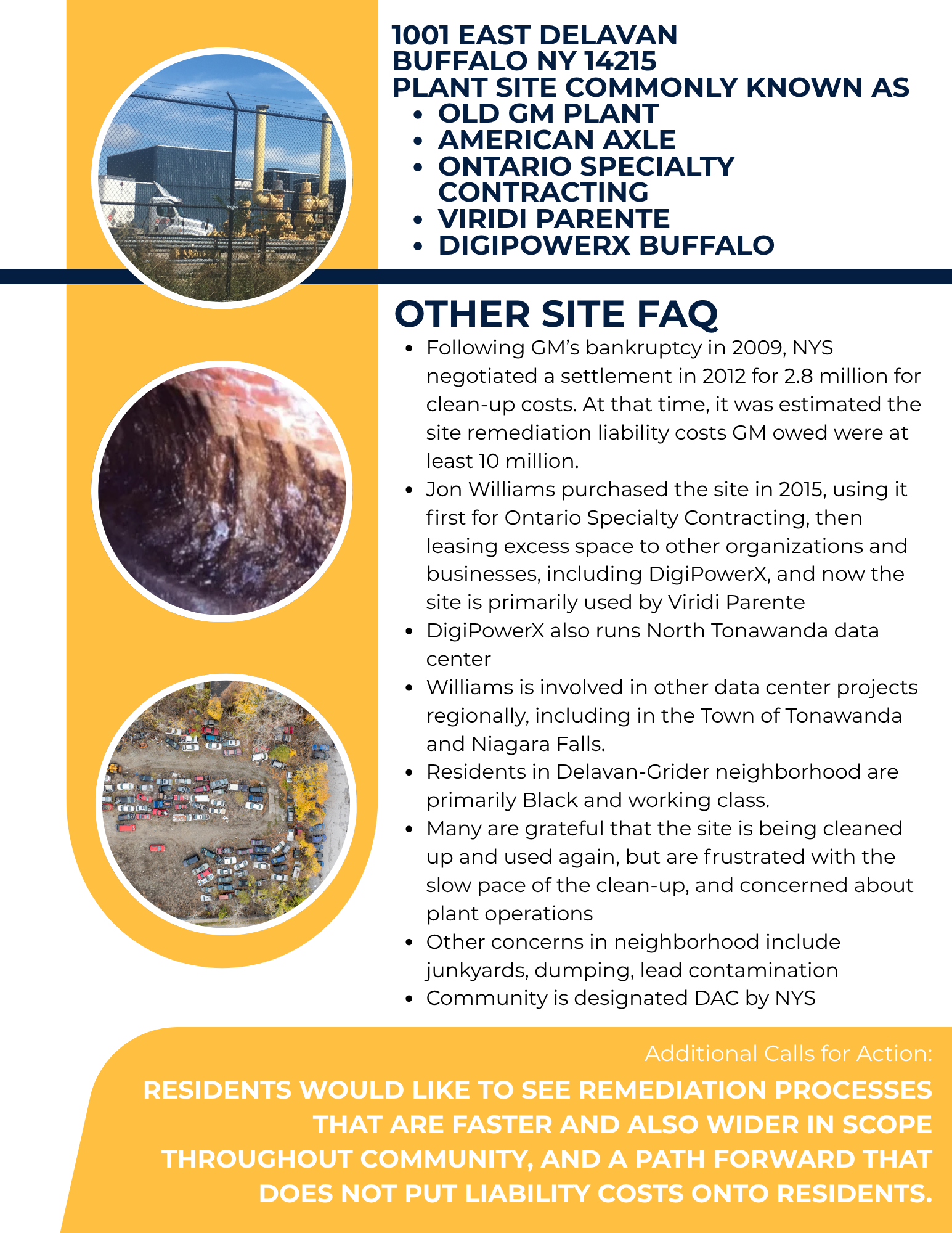
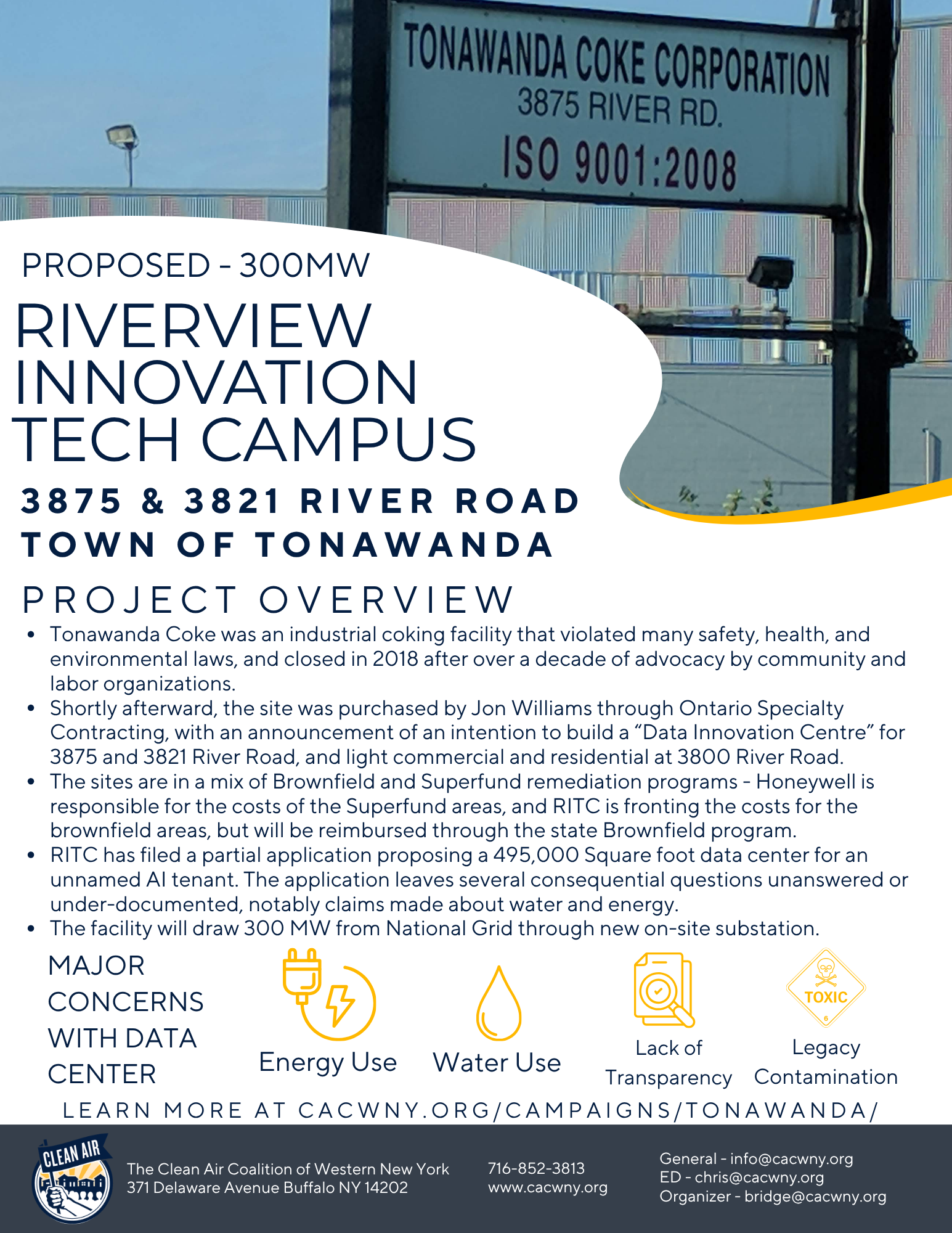
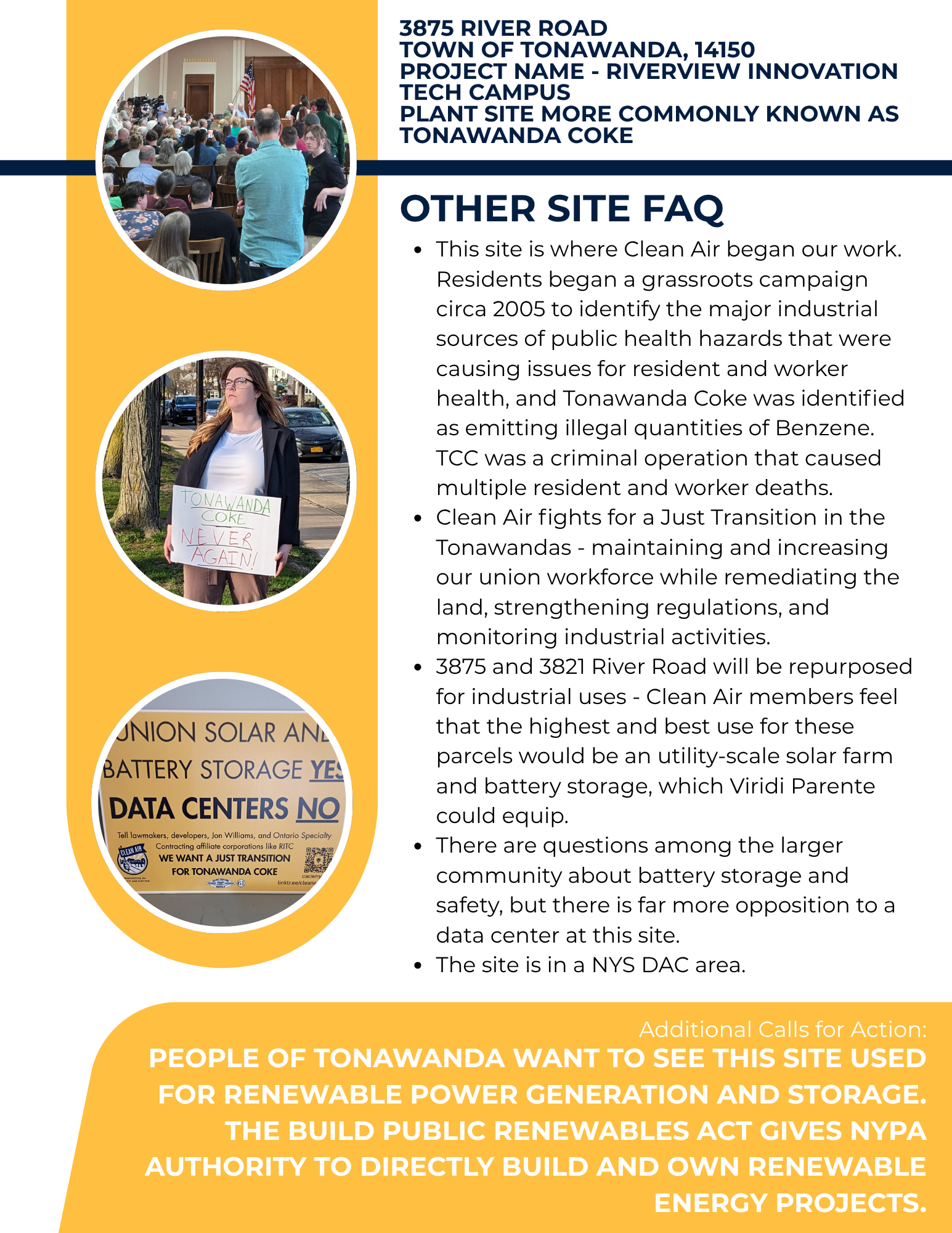
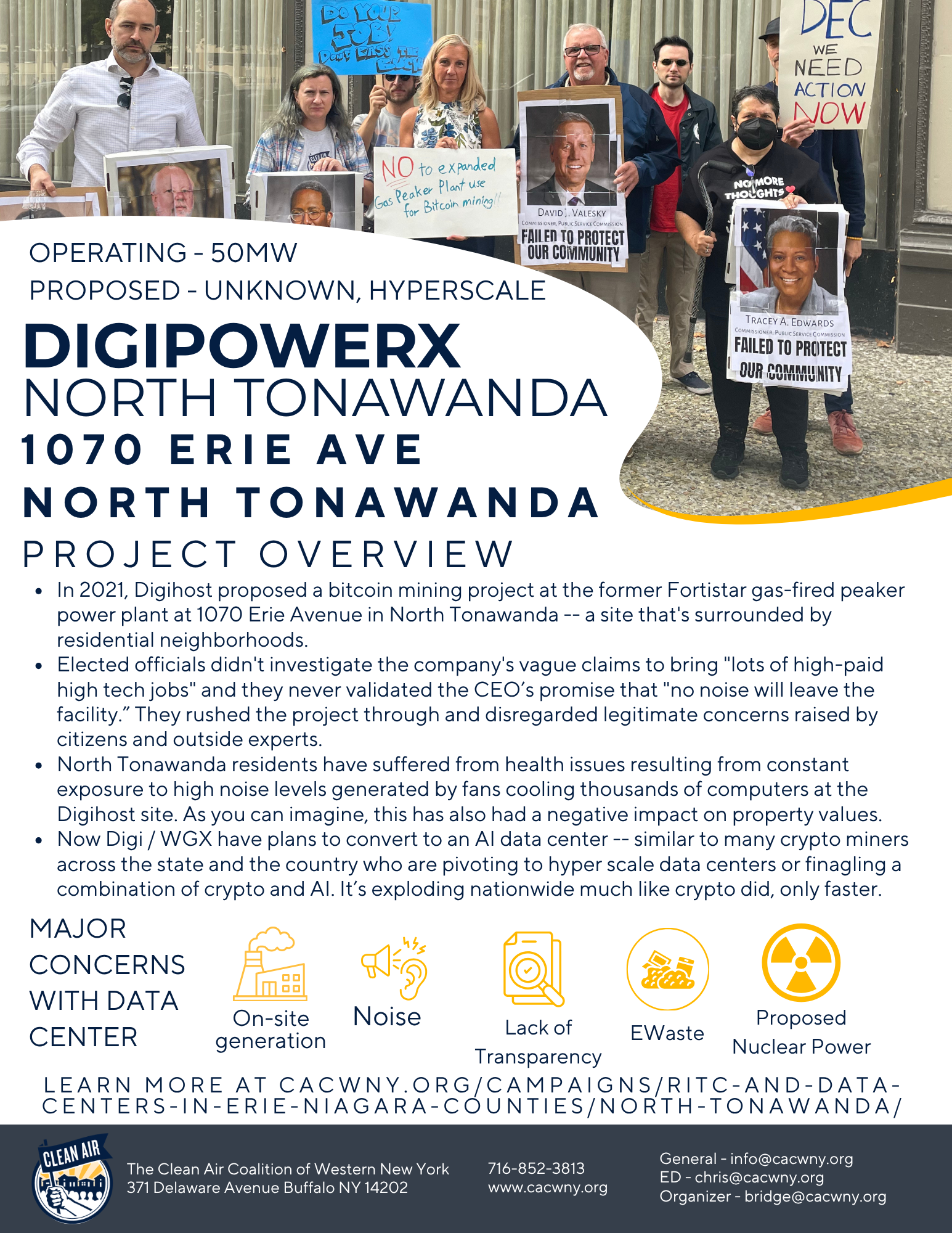
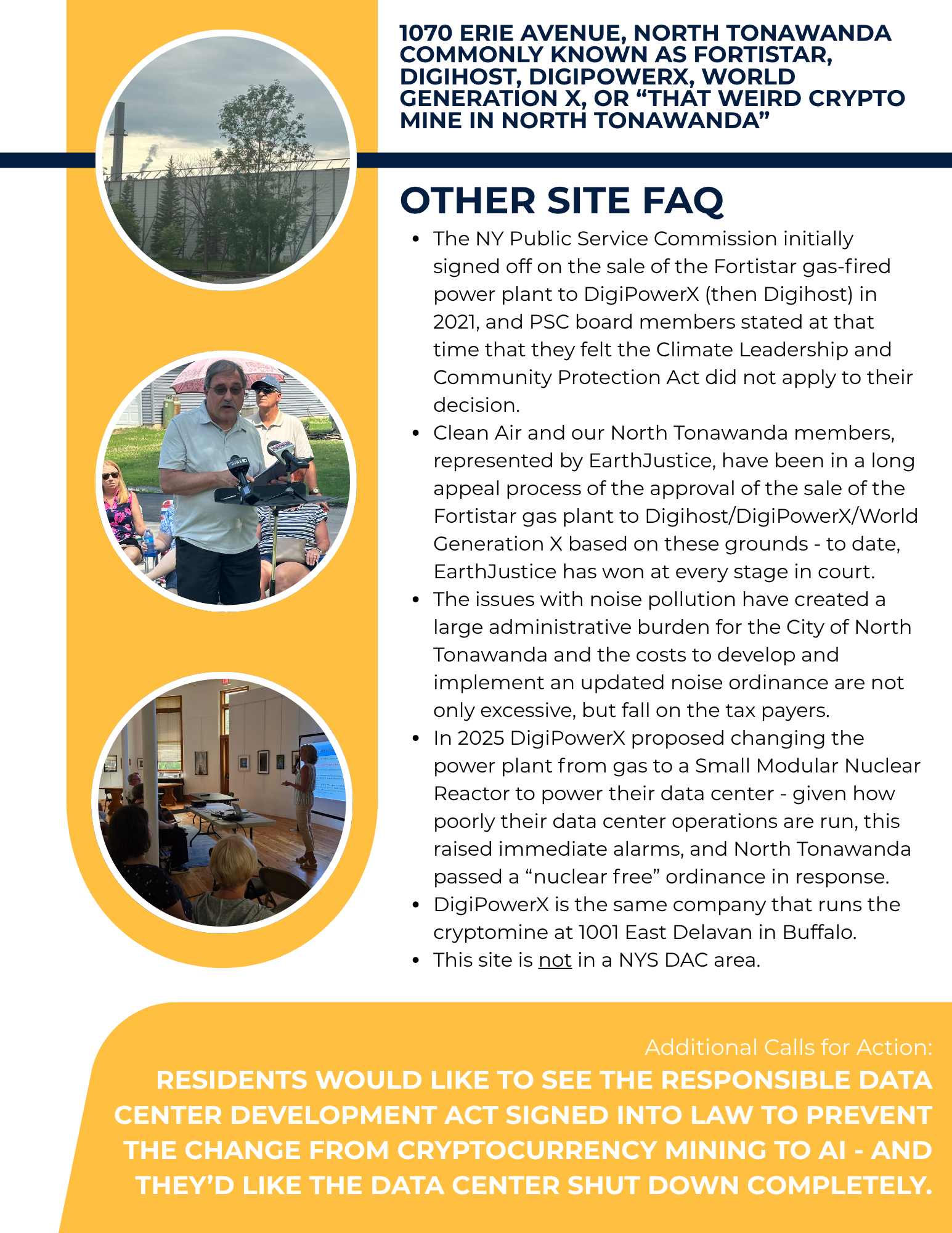
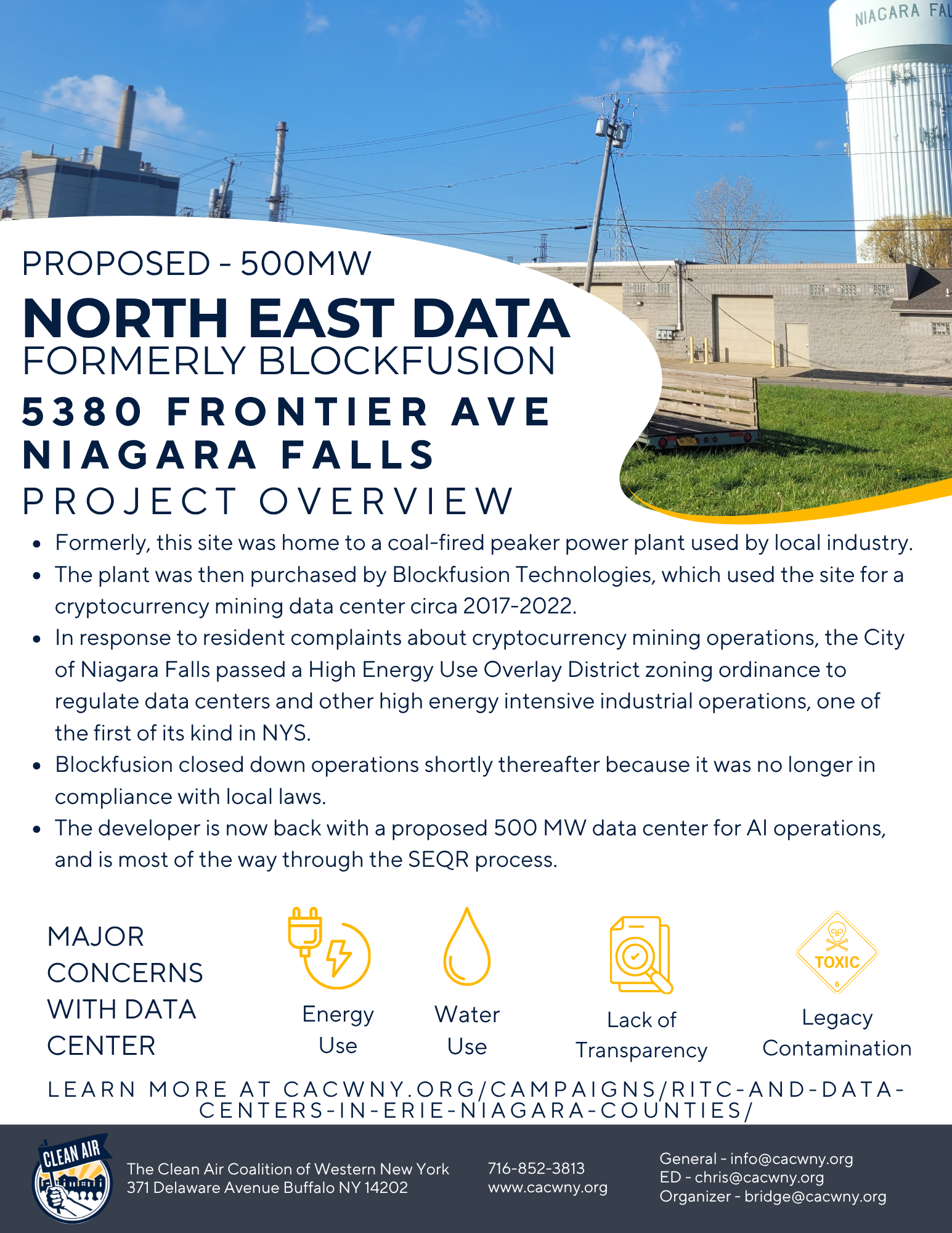
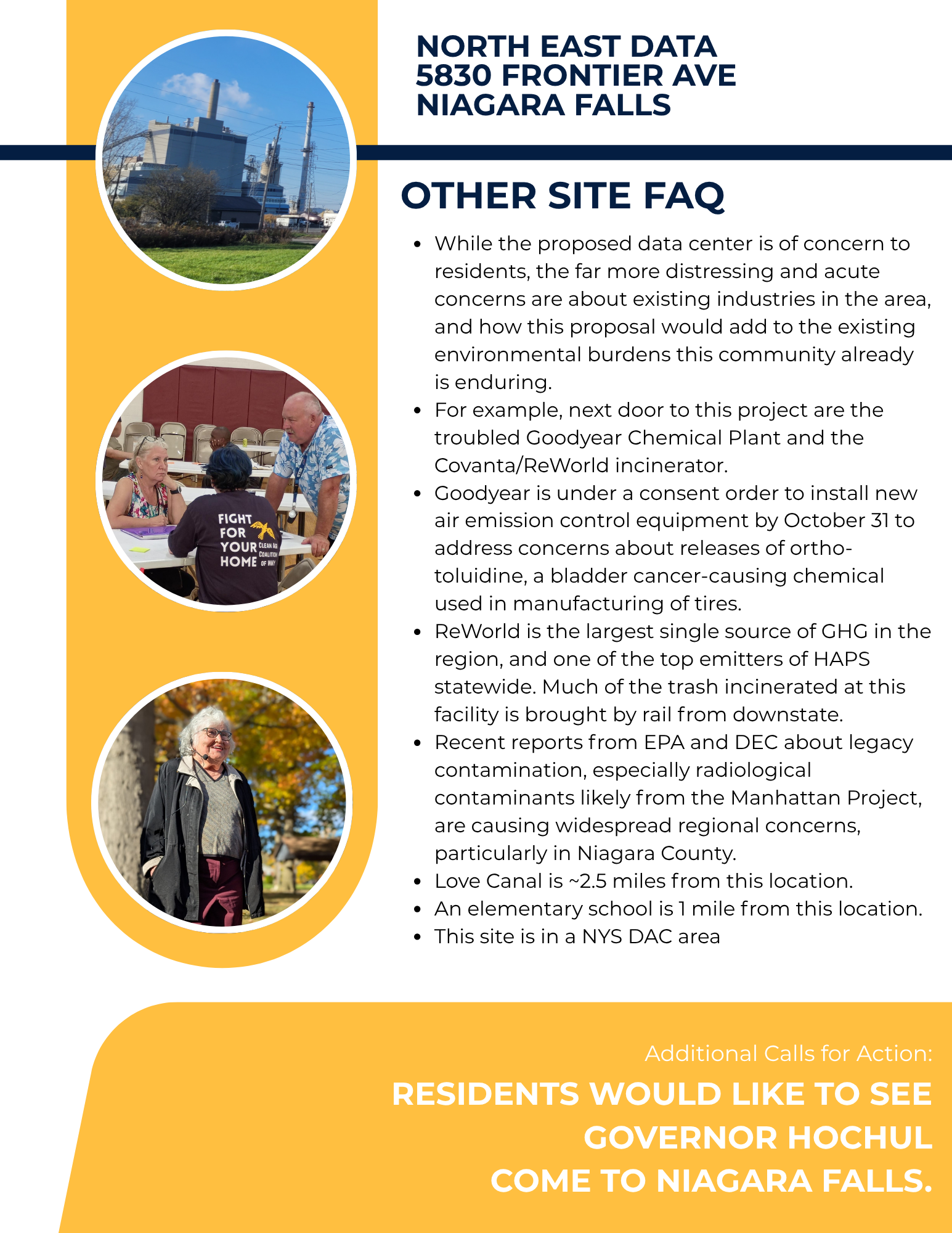
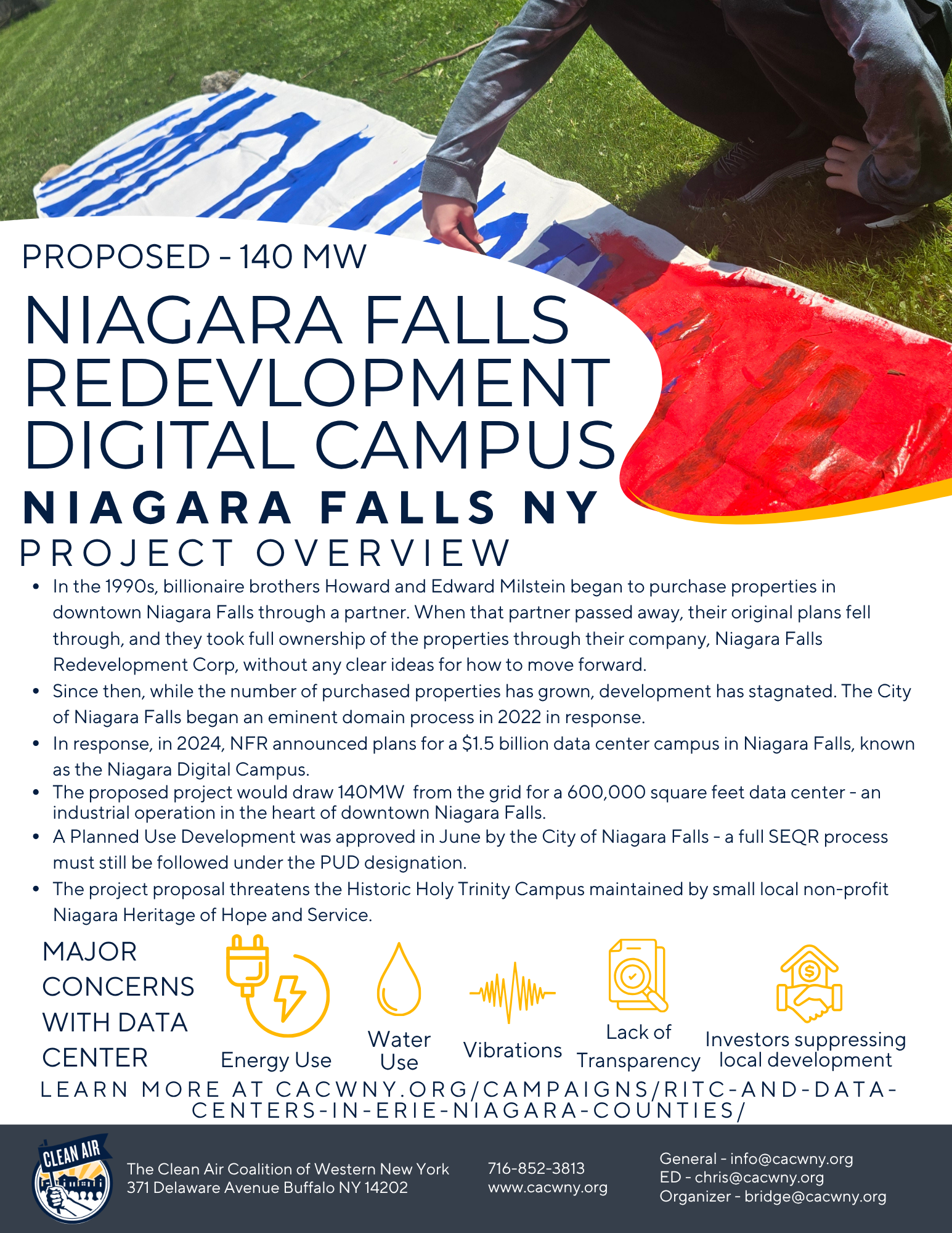
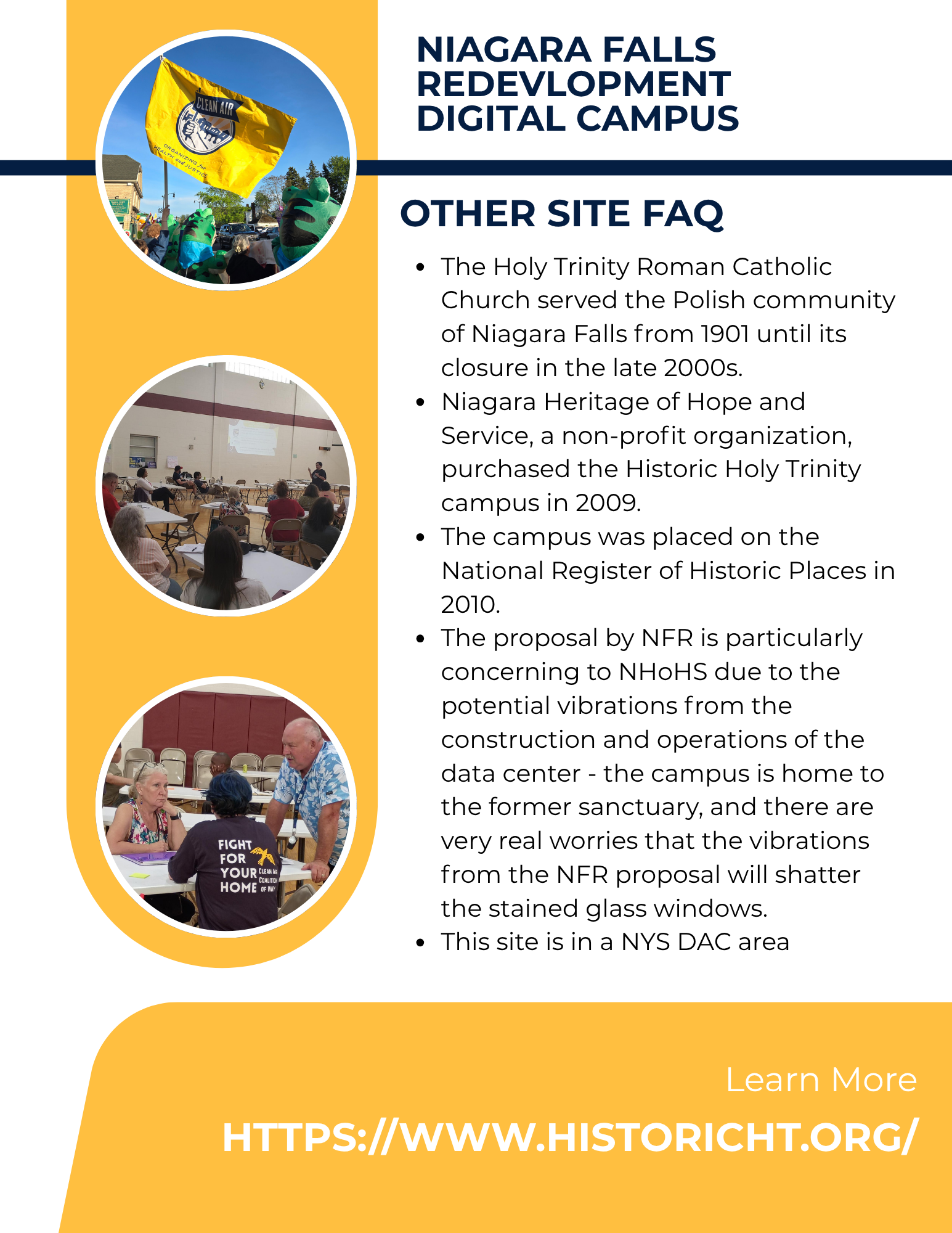
Instead of the initial plan for a single town hall in Buffalo, our members instead led her through two town halls in Buffalo and Niagara Falls, and to six separate site visit stops to operating or proposed data center sites – a stop at the Tesla plant where Elon Musk has pursued the “Dojo” supercomputer, one at 1001 East Delavan in Buffalo (the former American Axle) where DigiPowerX operates a 19MW cryptomine, the Riverview Innovation Tech Campus at the the former Tonawanda Coke site, a stop at a resident’s home in North Tonawanda affected by the troubled DigiPowerX site, and two in Niagara Falls, the proposed 500 MW North East Data project in the Buffalo Avenue corridor and a stop at a historic site threatened by the Niagara Falls Redevelopment 140MW proposal. At the town halls, we also invited residents from other site fights in Erie and Niagara that we were not able to fit in the tour, like the TeraWulf data center in Barker NY, to participate in the panel discussions.
At every site, Senator Gonzalez and other state and local elected officials heard from residents not only about how these projects have upended their lives, but about how these projects add to existing environmental justice burdens like the current radiological crisis currently unfolding, and their visions for a more equitable future of industry rooted not in the same extractive economics which have stolen from our communities for generations, but instead in unionized renewable energy generated by and for our area.
Hyperscale data centers may or may not have a future in WNY – but local communities should make that determination, and should determine their own guidelines for how these projects should be built and operated. The Governor signing the Responsible Data Centers Development Act would put us closer to that future – click here to send her a letter urging her to take this important next step, and click here to send a letter to the leadership of Ontario Specialty Contracting and RITC to urge them to change their planned future use of the former Tonawanda Coke site from a data center to renewable energy projects.
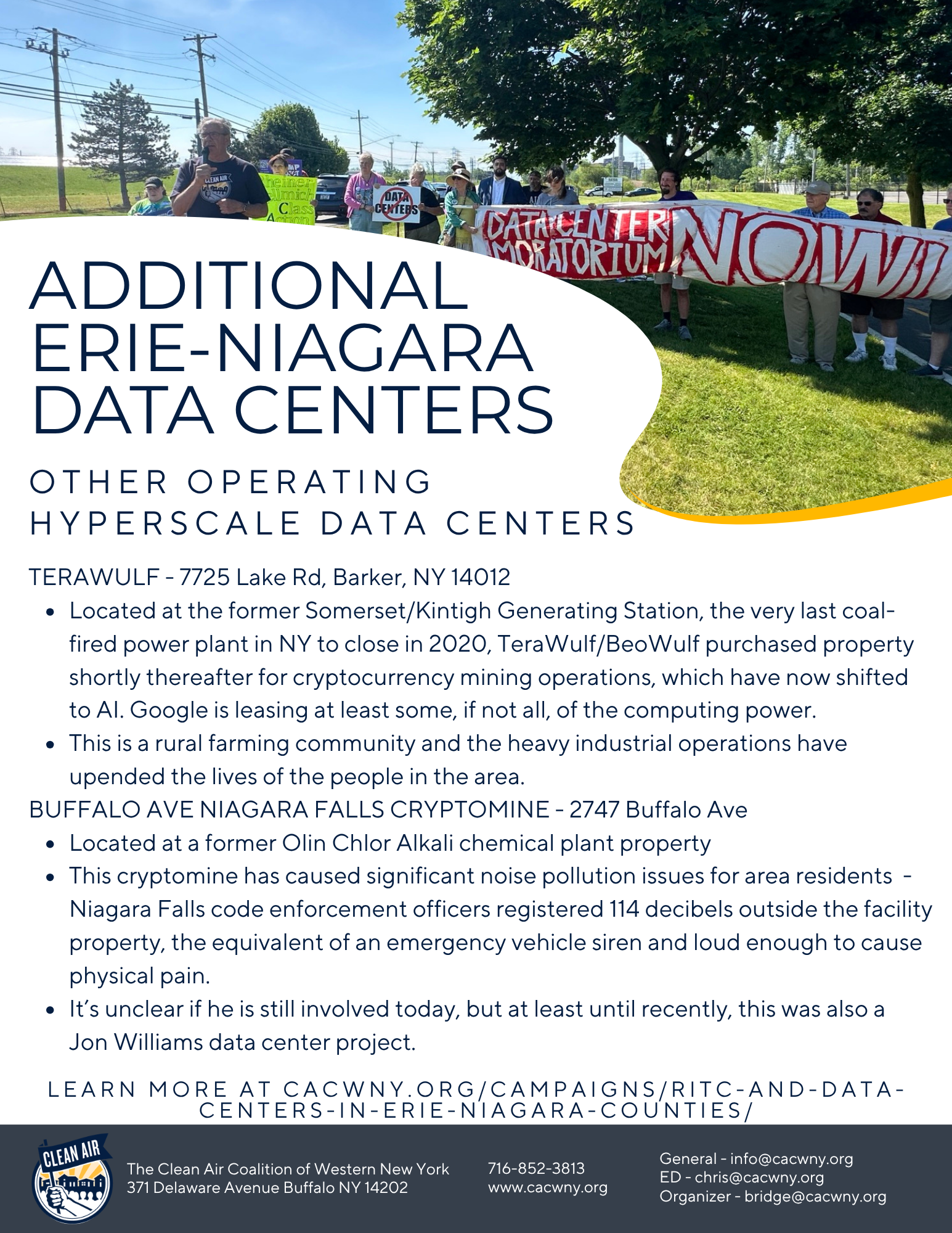
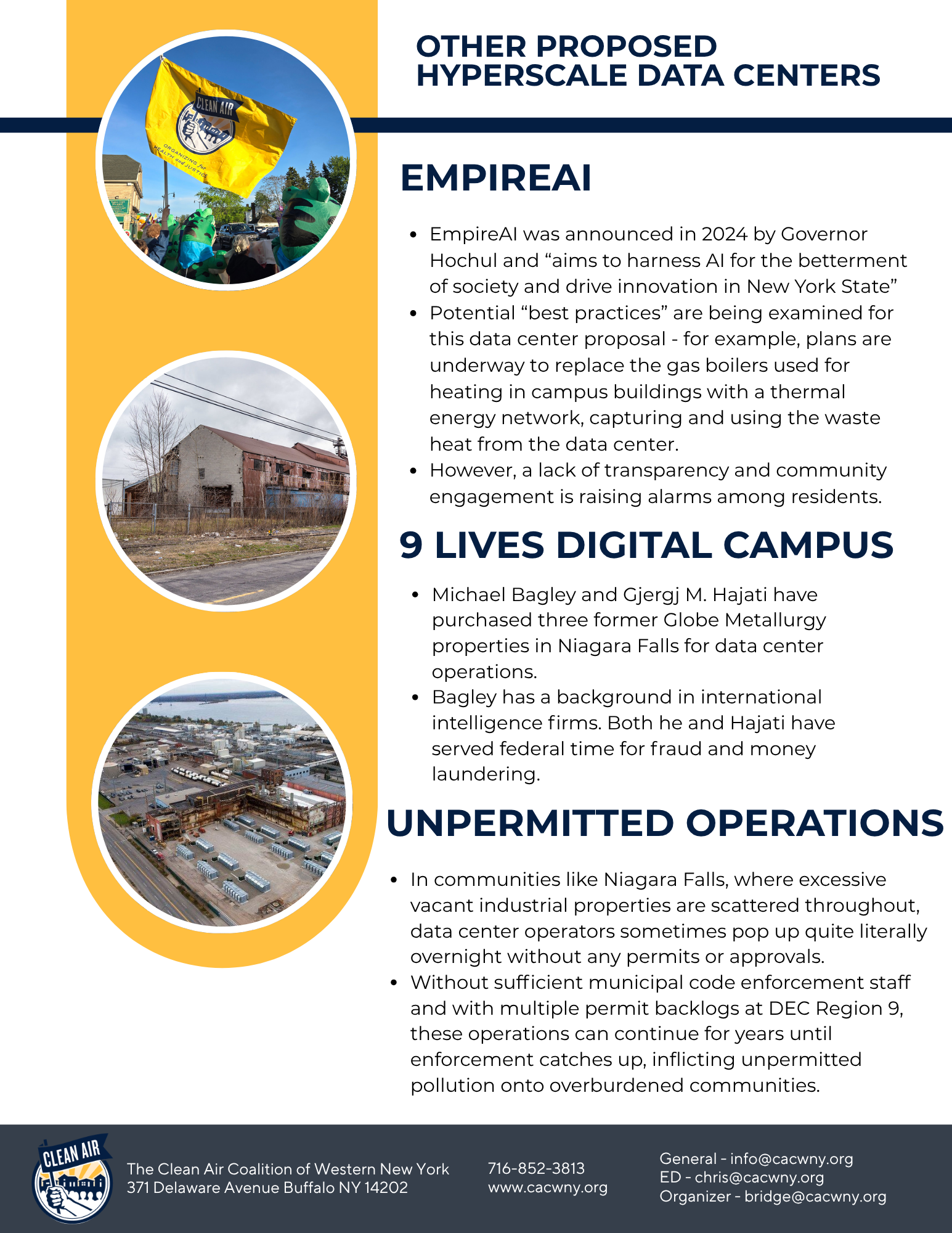
Below are some photos of the day, as well as FAQ sheets we developed and shared for each site.

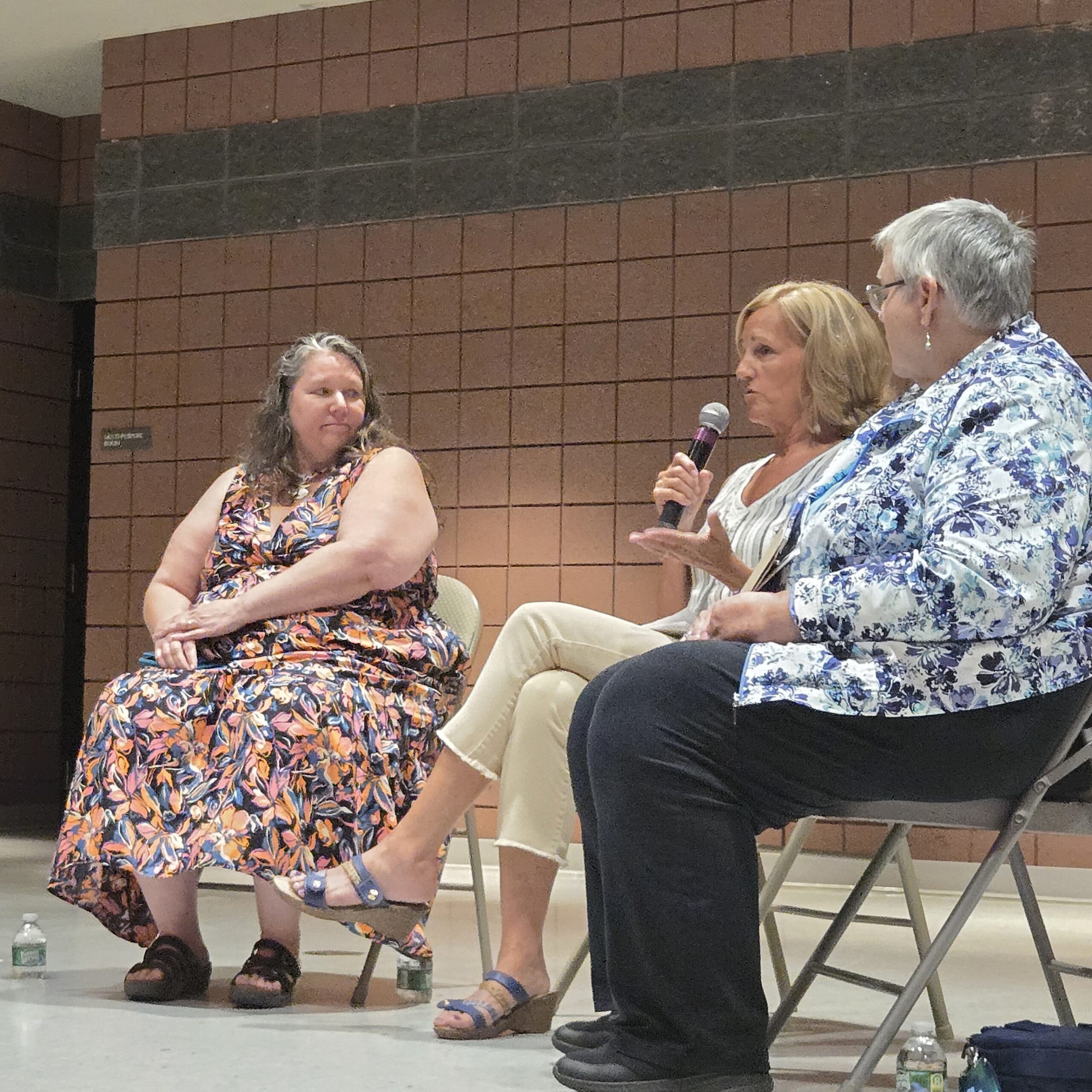
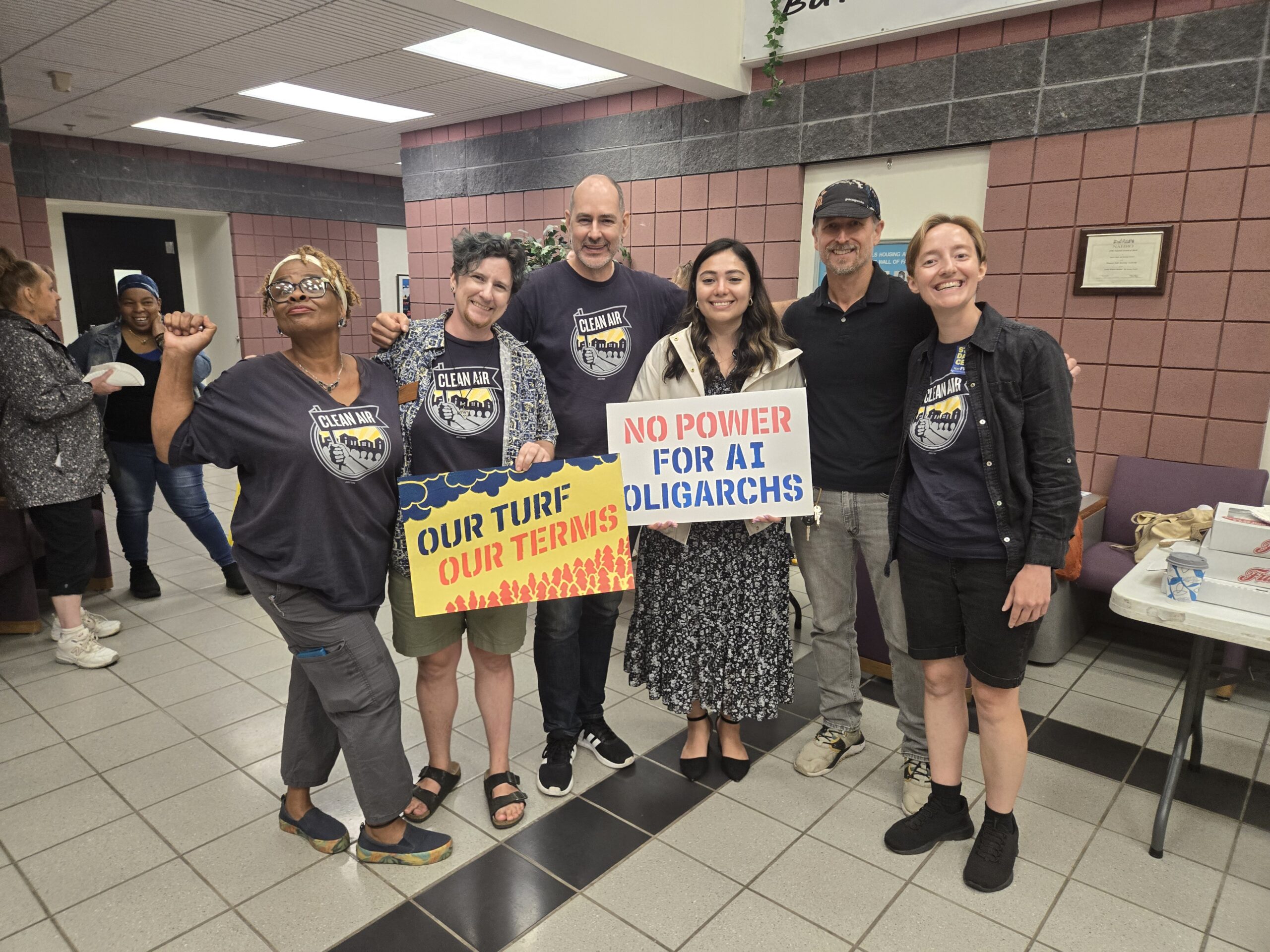
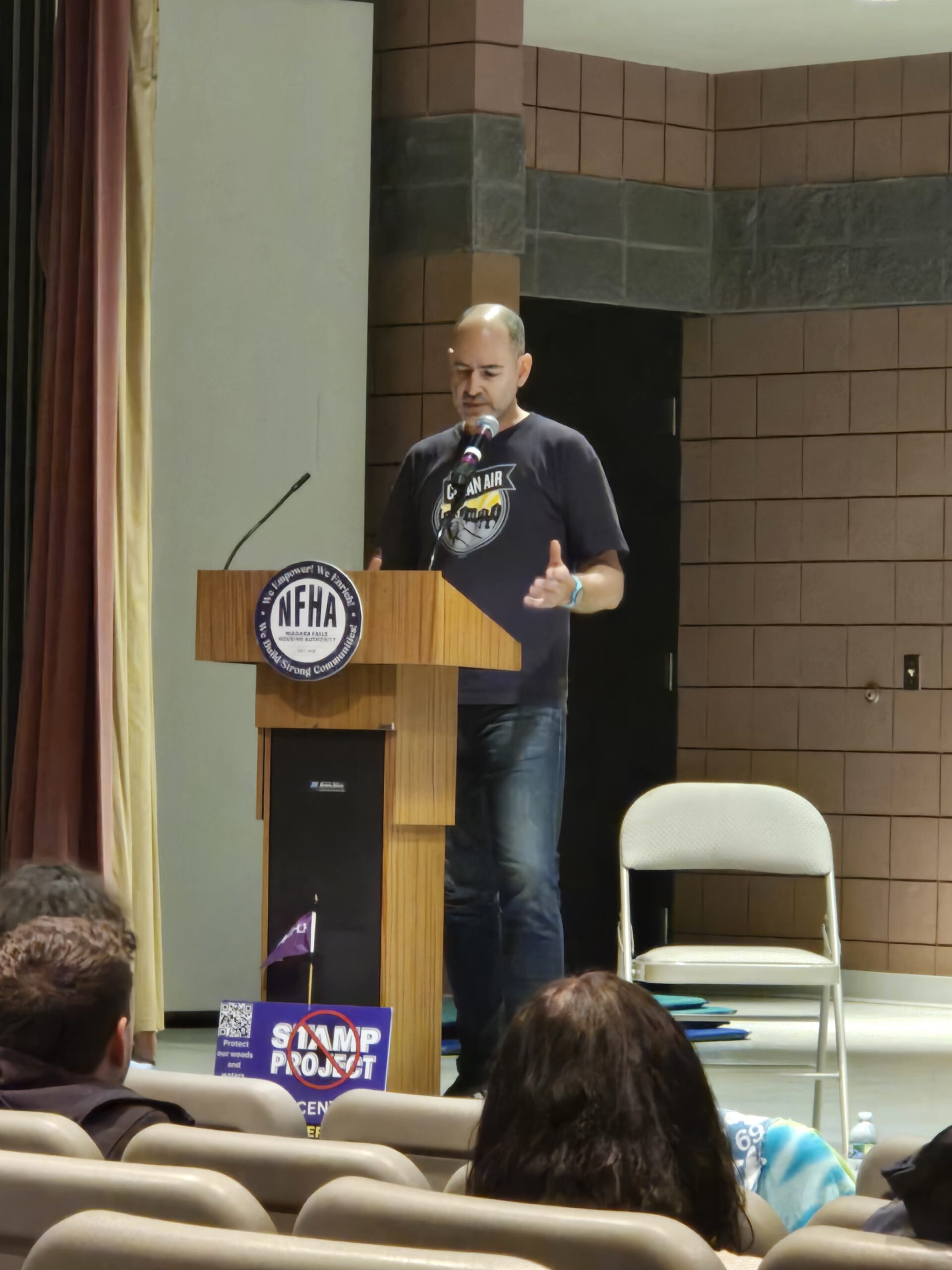
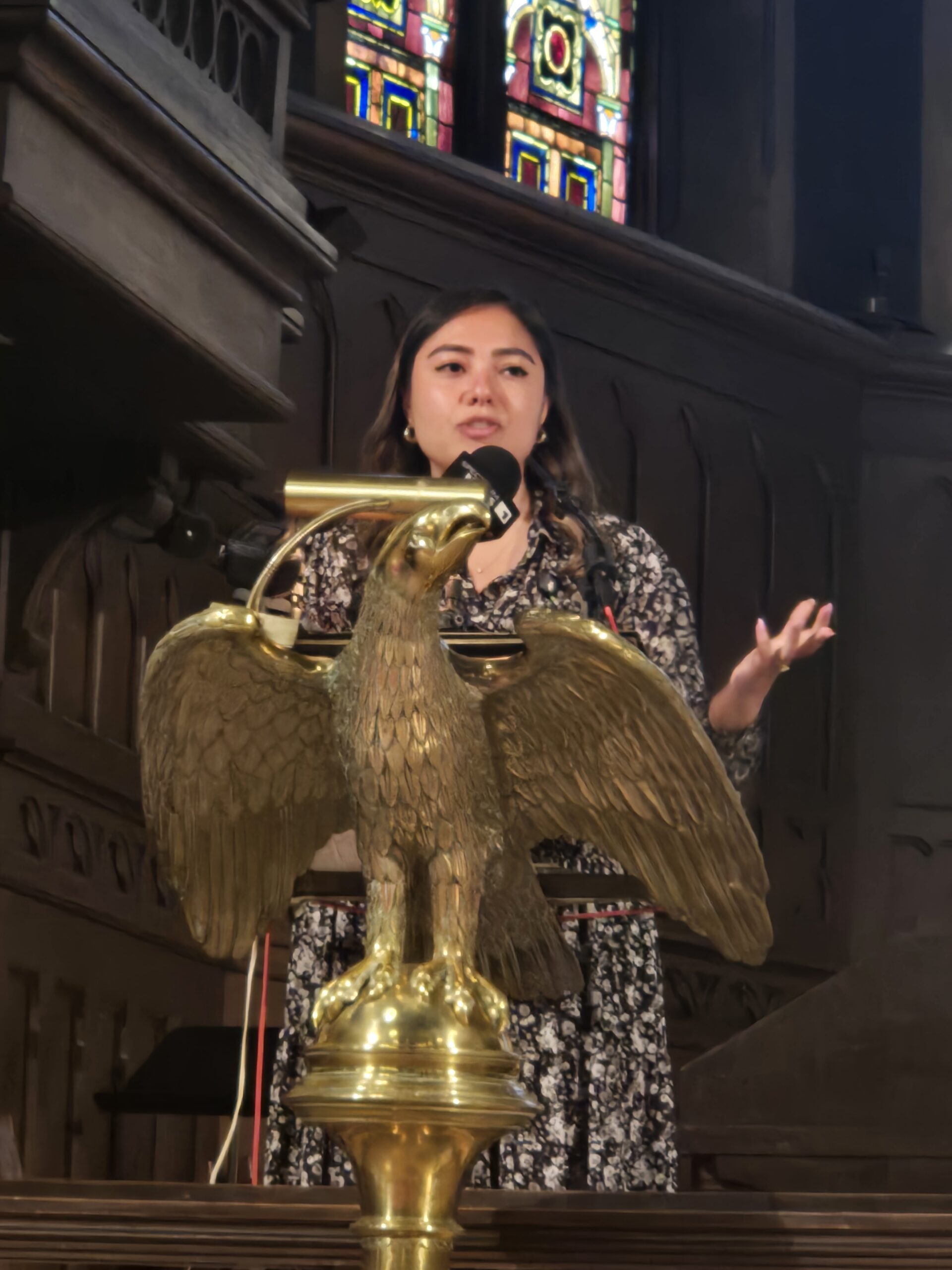
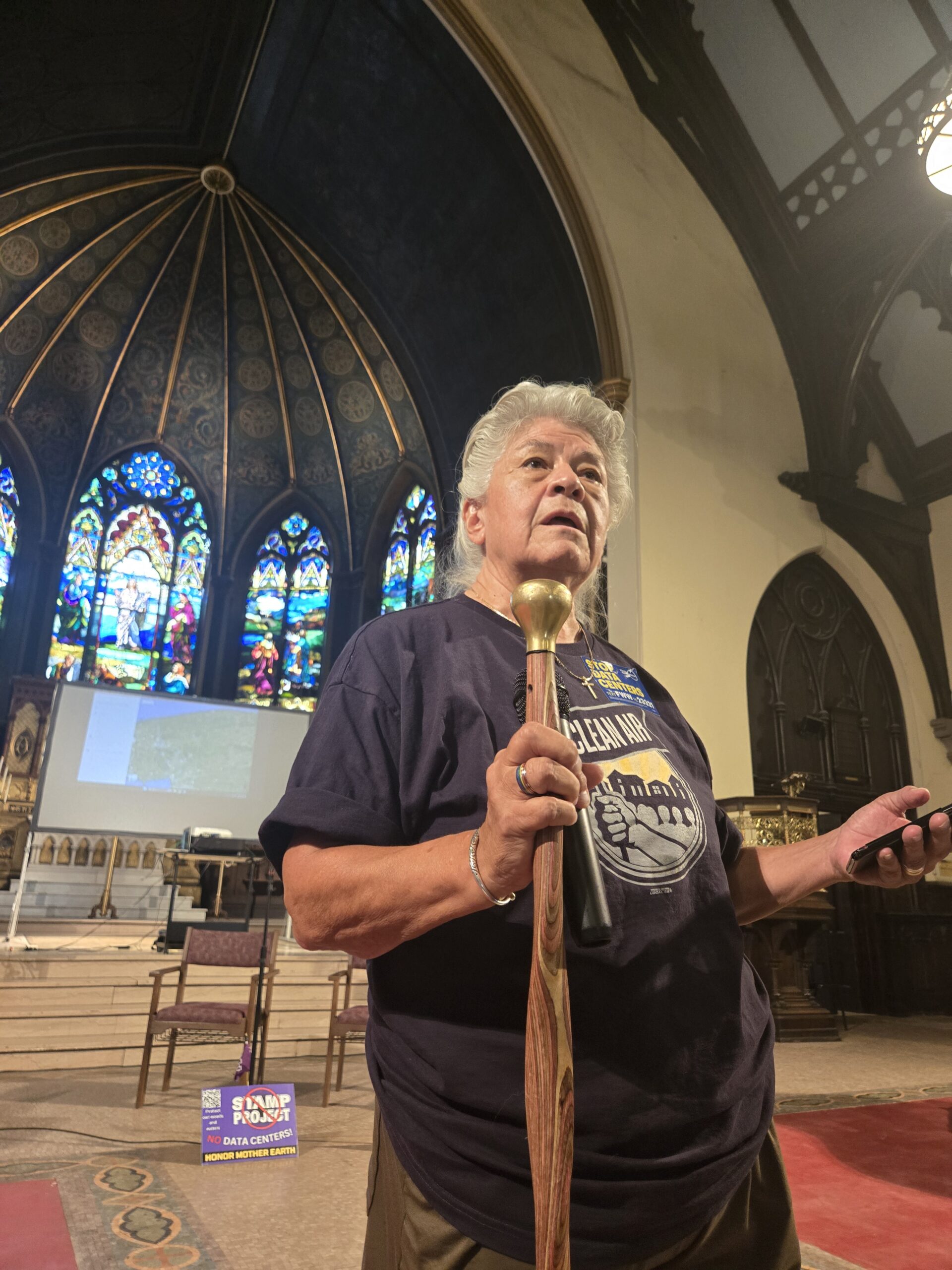
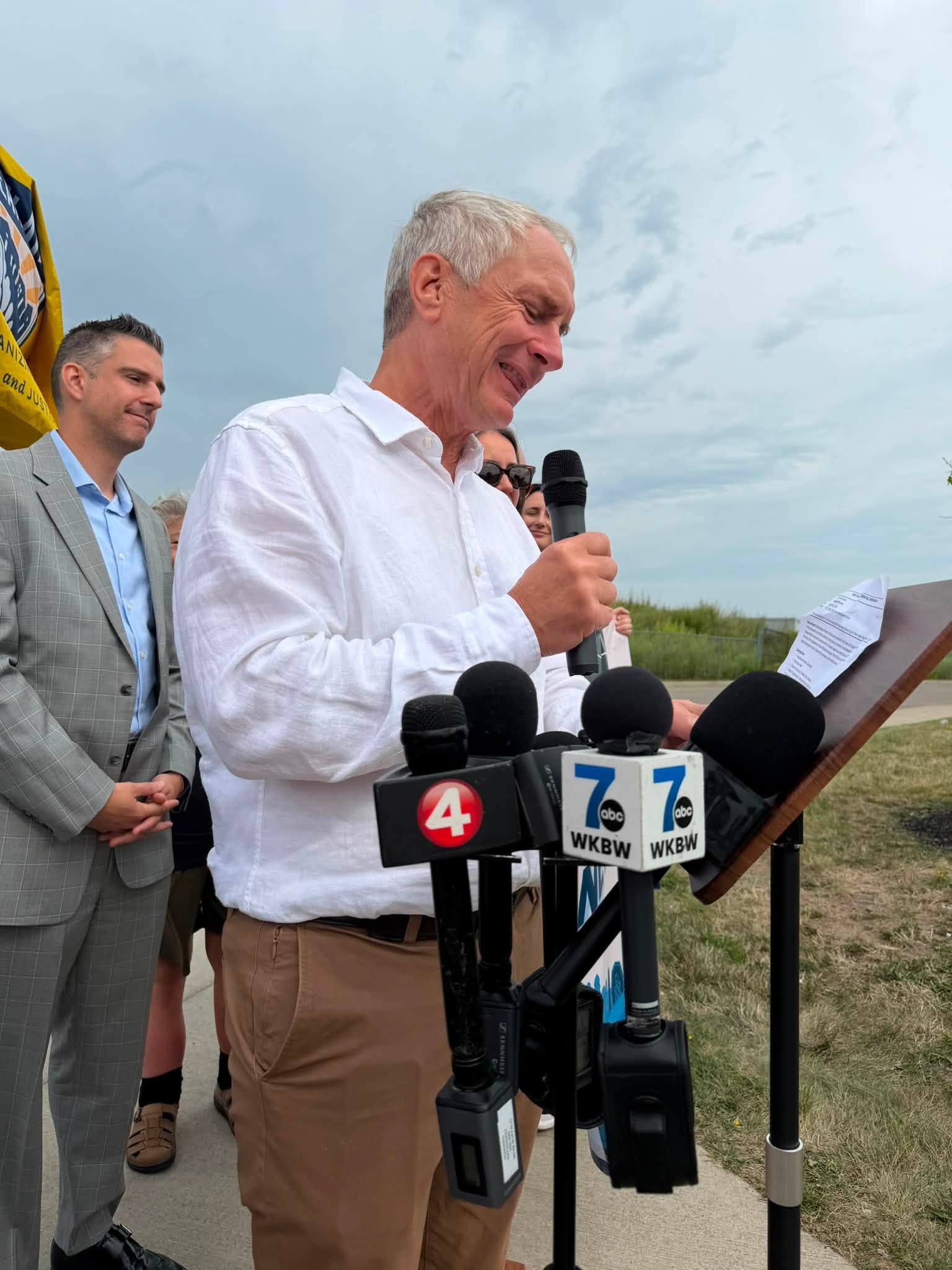
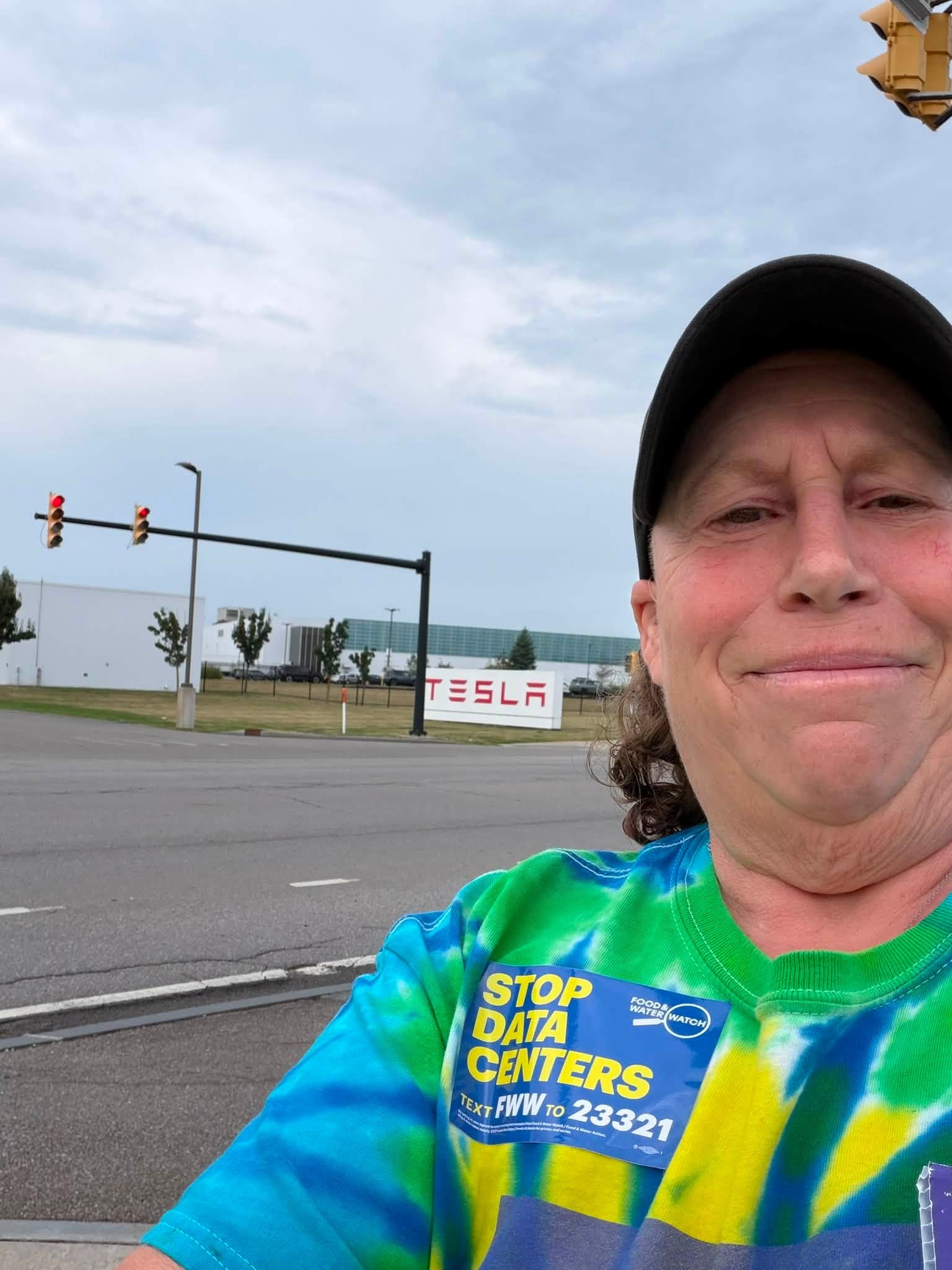
Data Center Town Halls with Senator Kristen Gonzalez
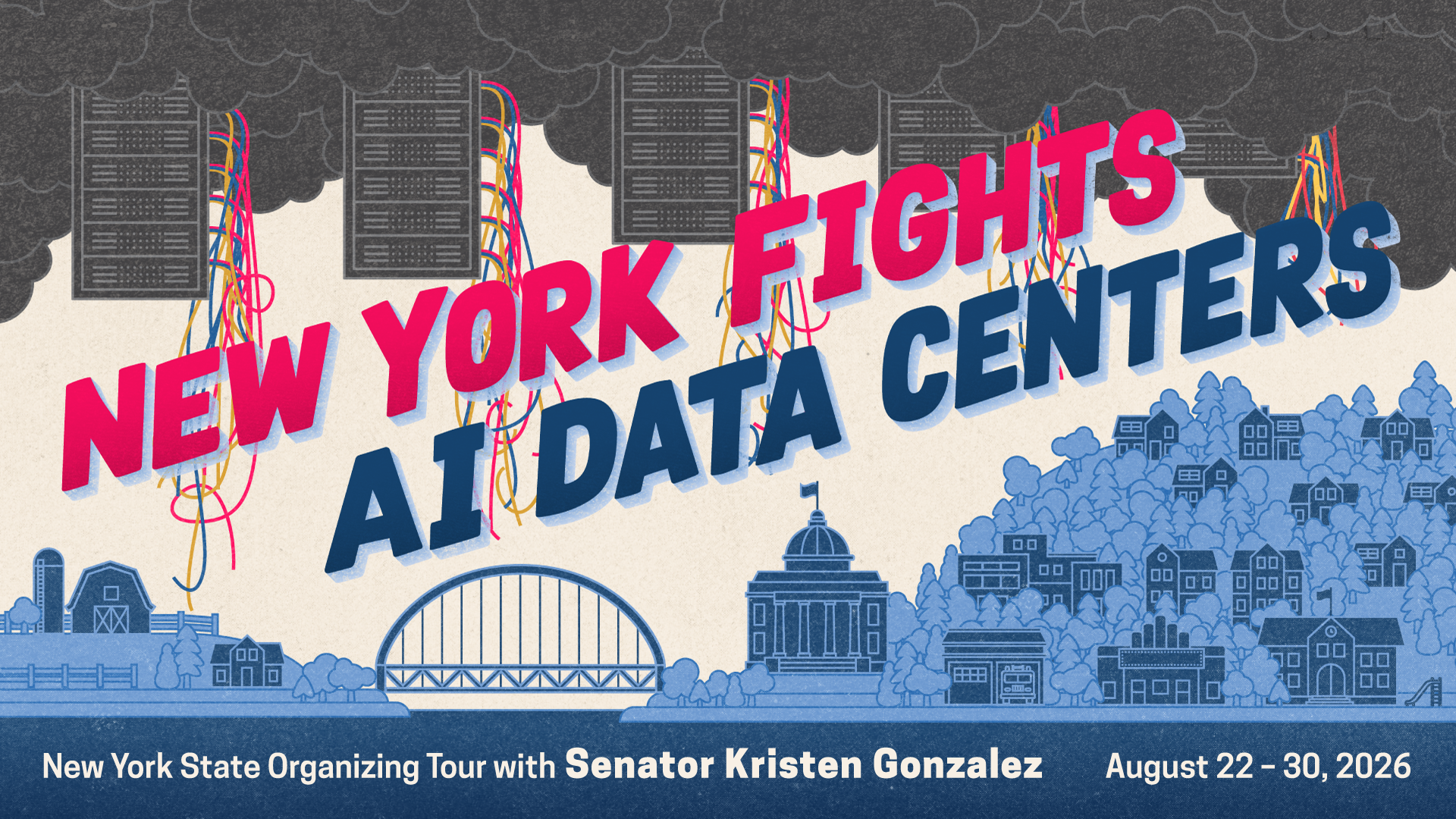
NY Fights AI Data Centers! With Senator Kristen Gonzalez
Join us in welcoming Senator Kristen Gonzalez to our region for two town halls regarding active and proposed data centers as part of her statewide data center tour!
We will hear from organizers about the data centers that are currently operating or are being considered in the area, learn from Senator Kristen Gonzalez about the Responsible Data Center Development Act, listen to a panel of community members speak on their site fights locally, and have a Q&A portion for audience members.
The morning will start with a Buffalo Town Hall at 11:30am at the Clean Air Coalition office, 371 Delaware Ave, Buffalo, NY 14202. During this town hall we will also hear from Senator Gonzalez about the tour stops she has planned for the rest of the day. You can register here for the Buffalo Town Hall: https://actionnetwork.org/events/kickoff-town-hall-with-sen-gonzalez/
The day will wrap up with a Niagara Falls Town Hall at 7pm at the Doris Jones Community Center Auditorium, 3001 9th St, Niagara Falls, NY 14305 US. At this event Senator Gonzalez will also speak on what she learned about the various local data center fights in the region throughout the day of community conversations. You can register here for the Niagara Falls Town Hall (note that the correct time is 7pm): https://actionnetwork.org/events/niagara-falls-fights-ai-data-centers-town-hall/
July-August 2026 Monthly Updates: Tonight Monday August 3 – Hearing in Town of Tonawanda for a Data Center Moratorium!
Click here to subscribe to our monthly e-newsletter, and view this month’s edition by clicking the “More” link just below.
Town of Tonawanda Hearing Monday August 3 2026 – Data Center Moratorium
We’re very excited to share that the Town of Tonawanda will hold a hearing on Monday August 3, 2026 at 7pm at 2919 Delaware Avenue at the beginning of the regularly scheduled Town Board meeting to vote on a proposed 1-year moratorium on hyperscale data centers above 20MW in size, and to then use the moratorium period develop a zoning amendment to regular data center operations.
The announcement of the hearing came one day prior to Governor Hochul’s Executive Order, and the proposed local moratorium helps cover some of the gaps in the Executive Order, such as the 50MW threshold.
We previously had posted a copy of the resolution but were asked by the town to remove it from our website. Contact Bridge at bridge@cacwny.org if you would like more details on the resolution.
Please join us on Monday August 3 at 7pm at 2919 Delaware Ave to support the passage of the moratorium, and voice any concerns you may have with it.
Typically, members of the public are given 3 minutes to speak during Town of Tonawanda public hearings, and the hearing will be one of the first items on the agenda and the meeting will start promptly at 7pm, so please plan to arrive a little early. Doors to the meeting should open around 6:30.
Clean Air members and organizers have been urging that town officials take this action for several years through our Tonawanda Just Transition Teams – we have grown increasingly alarmed by the impacts of data centers in other communities where we organize, such as in North Tonawanda, and by the quiet ongoing development towards the “Data Innovation Technology Centre” at the Riverview Innovation Tech Campus, formerly Tonawanda Coke.
A moratorium is a sensible short term action to take for local policymakers to develop a zoning amendment – to be clear, though, ultimately Clean Air’s goal is to pivot the planned use of the site from a data center to renewable energy generation and storage, and regardless of whether this moratorium passes or not, we will continue to campaign towards this goal, as well as our other related goals to rein in this new industrial sector.
Learn more about our Erie-Niagara Data Center Campaign here, and our Tonawanda Just Transition Teams here.
Clean Air Celebrates and Thanks Governor Hochul for Today’s Data Center Executive Order
Here at Clean Air, we are celebrating the news today of Governor Hochul’s Executive Order for a 1-year moratorium on data centers above 50 MW.
This order is attached to a number of broader actions, including developing a Draft Generic Environmental Impact Statement. We urge reading the full EO here – https://www.governor.ny.gov/executive-order/no-62-establishing-temporary-moratorium-data-centers-new-york-while-state-develops
Our statement celebrating this action today is shared below.
Clean Air Celebrates and Thanks Governor Hochul for Today’s Data Center Executive Order
The Clean Air Coalition of Western New York organizes with fenceline and frontline residents in Erie and Niagara County NY to organize to fight for environmental justice and public health.
We first became engaged in data center site fights with the closure of the former Tonawanda Coke in 2018 and the announcement at that time that the future planned use was a hyperscale data center – from the beginning, residents expressed skepticism and concern about this planned use. They have since grown increasingly vocal in their opposition to a data center at that site, and in favor of renewable energy generation and storage instead.
In parallel to this, cryptocurrency mining data centers in Erie and Niagara Counties began to pop up at area industrial sites, and in 2021 Clean Air began actively supporting data center site fights in our region, starting with the DigiPowerX cryptocurrency data center at the Fortistar gas-fired power plant in North Tonawanda.
We thank Governor Hochul for her action today to sign an Executive Order initiating a 1-year moratorium on all new data centers larger than 50 MW, or of expansions of existing data centers of similar size – this is a bold and innovative action by our Governor, and deserves applause. We especially applaud the inclusion of organized labor provisions within the proposed Community Investment Framework.
We urge that the Department of Public Service, Empire State Development, Department of Environmental Conservation and other named agencies engage with environmental justice organizations and fenceline communities across the state for the Draft Generic Environmental Impact Statement, the Community Investment Framework, and the Data Center Interconnection Working Group.
We further urge that, as the New York Grid Acceleration Fund begins to take shape, that investments in publicly owned renewable energy projects and supportive transmission and distribution be strongly considered.
We also urge that local governments not consider this action to supersede local actions, such as developing zoning amendments to fit individual municipal concerns, and also flag that smaller data centers between 10-50MW are not included in the moratorium, so we would urge continuing to pursue local moratoriums to restrict these new developments.
For example, we urge that the Town of Tonawanda continue to pursue the planned hearing on August 3 to initiate a 6-month moratorium, as there are local zoning actions that can still begin to be initiated during this one year pause.
The Governor’s actions today are worth celebrating – this is a huge win for communities and grassroots organizers who fight for action to rein in this unregulated industrial sector.
We again thank the Governor, as well as all our members and supporters who have worked tirelessly this year to bring about this action.
June-July 2026 Monthly Updates: General Meeting July 22 and Much, Much More!
Click here to subscribe to our monthly e-newsletter, and view this month’s edition by clicking the “More” link just below.