Take Action Today for Environmental and Climate Justice!
We currently have two actions you can take right now from where you are sitting for environmental and climate justice!
Click here to send a letter to your State Senator to urge them to support S6486D, which would institute a two-year moratorium on the use of privatized fossil fuel power generation for the sole purpose of powering Proof-of-Work Blockchain Mining, i.e., cryptocurrency/Bitcoin mining. The legislative session ends June 10, but we are encouraging the State Senate to act before the end of the session to bring this bill to a vote.
Click here to sign our letter to the Climate Action Council to urge them to support stronger Just Transition actions within the final Scoping Plan for the Climate Leadership and Community Protection Act (CLCPA). We will be submitting the letter on Monday June 6th, so ask that our members and supporters sign the letter by Friday June 3rd. You can also submit comments directly by June 10 by clicking here.
Both of these one-click actions will literally only take a few seconds!
Tonawanda Community Building Events
Save the Date(s)!
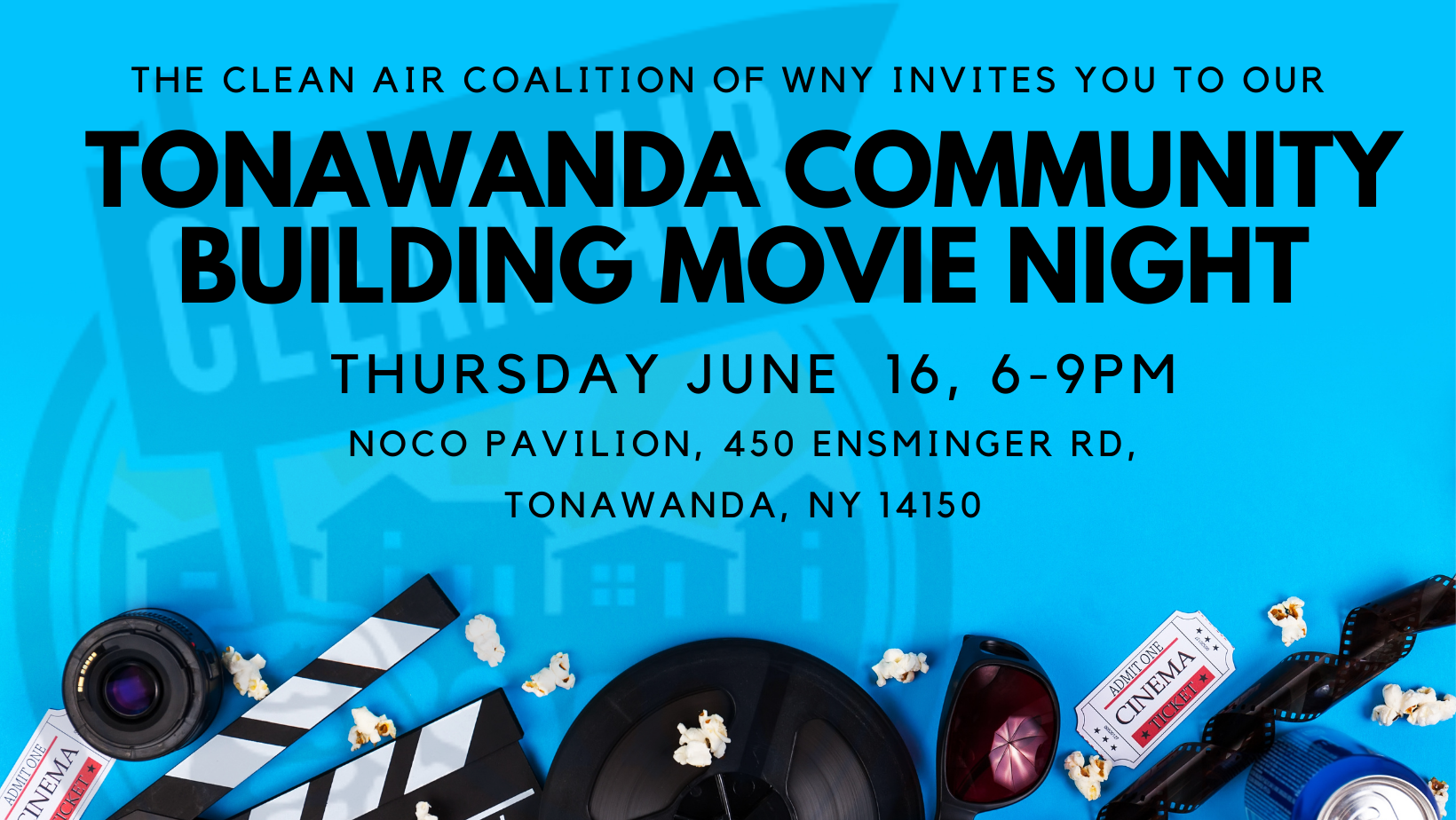
Join us on Thursday June 16 from 6-9pm at the NOCO Pavilion at 450 Ensminger Road in Tonawanda for a free film screening and community building party! We recently worked with Dr. Liv Yoon of Columbia University to make a documentary about Environmental Justice in Tonawanda, and are excited to watch it with you – join us for an evening of free food and fun! Click here to RSVP on Facebook, and here to RSVP using ActionNetwork.
We are also co-hosting a Pedal Party with Slow Roll Buffalo and LaBella Associates on Friday June 17 – the party will kick off at 7pm at North End Bar & Grill at 2692 Elmwood Ave in Kenmore and will circle back there later that evening. We will update this post when a Facebook event is posted, and you can also learn more and add a calendar reminder by visiting Slow Roll’s page.
Take Action for a Just Transition
Click here to read and sign our letter to the Climate Action Council calling for stronger Just Transition measures in the CLCPA Draft Scoping Plan, or sign the letter here –
Last week, we joined other members of NY Renews at the Climate Action Council public hearing on the Climate Leadership and Community Protection Act Draft Scoping Plan.
We are now asking our members and supporters to take a moment to sign our letter to the Climate Action Council with our expanded public comment calling for stronger Just Transition measures within the CLCPA Draft Scoping Plan. Click here to read and sign our letter by Friday June 3rd to sign our letter in support, and also consider sending a letter yourself either directly to NYSERDA or by using NYRenews’ one-click section-by-section toolkit by Friday June 10.
Coverage of the hearing from WGRZ –
Member Sticker Design Contest – chance to win $100!
We’re holding a member sticker design contest, with a chance to win $100! Submit your design for a sticker for the Clean Air Coalition by emailing Bridge a PNG or JPG 1080×1080 px or smaller in size by 5pm on Friday May 20. After submissions are received, we will hold a membership poll for the favorite designs, and will pick three winners who will receive $100 each.

Our voices were heard at Honeywell’s annual shareholder meeting!
Clean Air Members’ Voices Heard at Honeywell Annual Shareholder Meeting
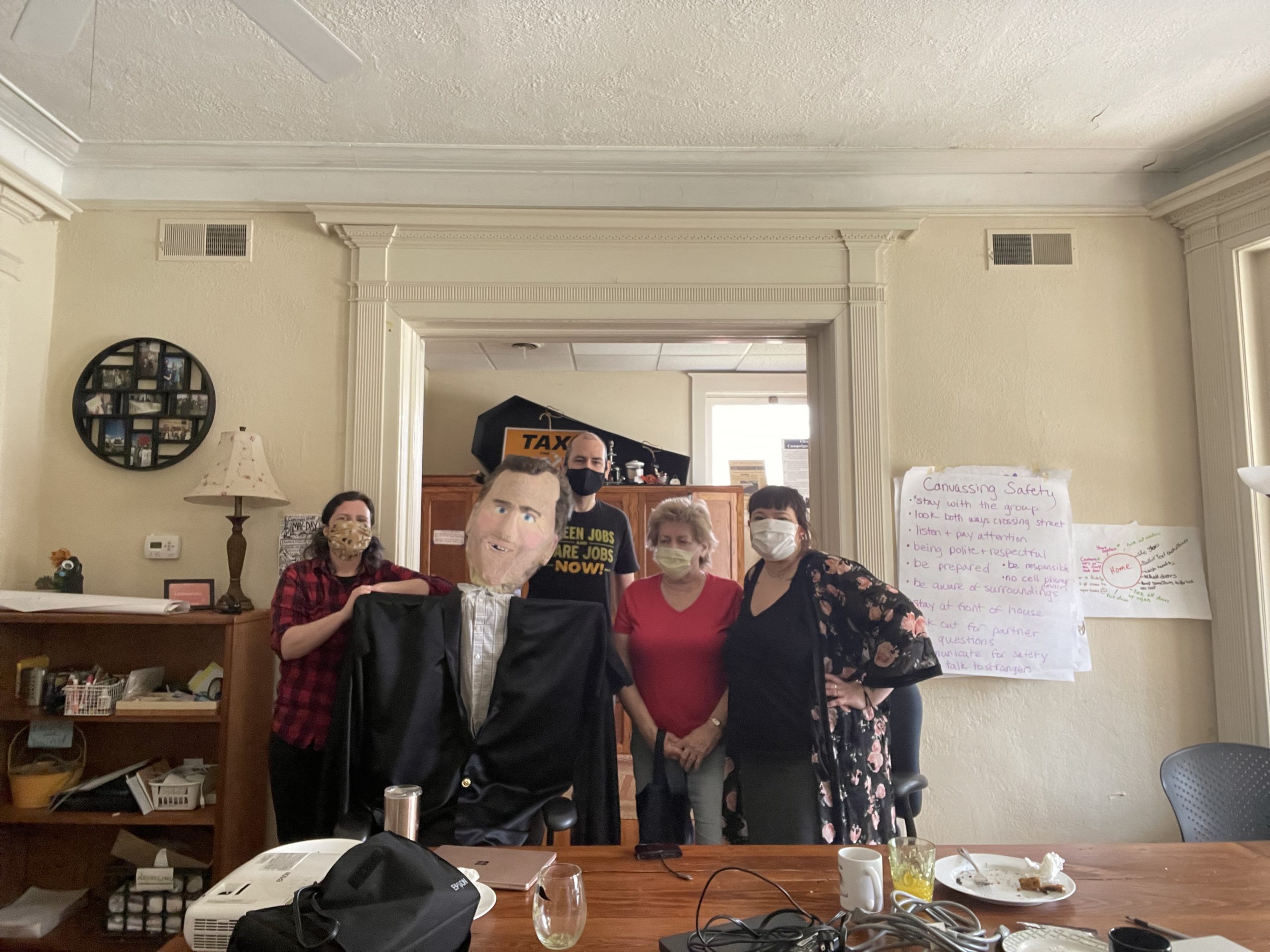
Today, Clean Air member Maria Tisby provided a powerful statement to Honeywell International Shareholders at their annual meeting. Maria shared how the company needs to center human health and environmental justice and be proactive, transparent and just in their remediation efforts around the globe.
Clean Air was give the incredible opportunity to speak and have our voices heard thanks to the Franciscan Sisters of Allegany and the Investor Advocates for Social Justice. We want to give a special thank you to Sister Gloria, Sister Pat and Jillianne Lyon of IASJ.
You can read the full shareholder proposal here and read Maria’s speech here!
The CLCPA, the Draft Scoping Plan, and Public Hearing April 27
What – Rally and speak out for climate justice at the CLCPA Draft Scoping Plan Hearing in Buffalo!
When – Wednesday April 27, rally starts at 2:30pm, hearing starts at 3:30pm
Where – The Buffalo Central Library, 1 Lafayette Square, Buffalo NY
We recently covered what the Climate Leadership and Community Protection Act (CLCPA) is and how this groundbreaking legislation starts to put NY on the path of climate resiliency and towards a just transition. The CLCPA’s Draft Scoping Plan, which, when completed, will set the framework for implementation, is now available for public review and comment and NYSERDA (the NYS Energy Research and Development Authority) is holding multiple public hearings on the draft, including one here in Buffalo at the Central Library (1 Lafayette Square) on Wednesday April 27 starting at 3:30pm. Speakers at the hearing will have 2 minutes and do not need to pre-register, but are encouraged to do so.
We need you to join us! We’ll be meeting up with other environmental and climate justice organizations at 2:30pm prior to the hearing out front of the library for a rally before heading in for the hearing, and we will remain for the length of the hearing, which we expect will continue into the evening.
Can’t make it on the 27th? There will also be two online hearings on May 7 and May 11. We also encourage everyone to submit public comments between now and June 10 – our partners at NY Renews have a one-click tool you can use and you can also submit comments directly here.
NY Renews will also be holding two training sessions on Zoom on April 25 and May 9 to prepare for the public hearings – click here to register.
The following list is of resources that you may find helpful for preparing your remarks –
- General
- NY Renews
- Sierra Club
- Section-by-section breakdown of plan
We also held a training for our members with Sierra Club, which you can watch here –
We look forward to seeing you on Wednesday April 27 at 2:30pm at the Buffalo Central Library!
We are hiring a Just Transition Organizer!
We are so excited to announce that we are hiring a new Just Transition Orga nizer!
Are you passionate about building grassroots power with poor and working class communities? Do you have a drive to push anti-racist policy in our climate just movement? Do you want to work on a team that values your leadership development and organizing skills? Then apply for our open Just Transition Organizer position by May 8th!
Check out our job description and send a resume, cover letter and work sample to jobs@cacwny.org!
We can’t wait for you to join our team!
Rebuttal to the Another Voice Column from Blockfusion Representative in The Buffalo News
In rebuttal to this column published in The Buffalo News on March 1 from Blockfusion, we submitted the following rebuttal to the Another Voice section, but it unfortunately was not accepted for print, so we are instead publishing it here to our blog.
The Clean Air Coalition of WNY disagrees strongly with the assertions made in the March 1 letter from Blockfusion representative Alex Martini-LoManto.
Blockfusion, like the vast majority of blockchain validation operations, relies on Proof-of-Work verification, which, in short, is a competitive process that uses computers to brute-force solve an equation in a winner-takes-all race against other Proof-of-Work blockchain operations.
This process is hugely energy intensive – the University at Cambridge estimates that the approximately 1 million blockchain validators worldwide “mining” for Bitcoin currently consume 130 TwH annually, which is more than entire nations, including Sweden, Kuwait or Argentina. To bring it closer to home, the US Energy Information Administration estimates that NY, in 2019 with 19.45 million residents and all our industries, consumed 145.6 TWh of electricity – this tiny industry with 1/19th our population size uses 89% as much!
Even more disturbingly, this rate of energy consumption is growing exponentially annually.
Not all operations rely on Proof-of-Work – some rely on Proof-of-Stake, which essentially shifts the blockchain “mining” from a competitive model to a cooperative one. Estimates by researchers at the Ethereum Foundation put the potential cut in energy consumption at 99.95%, making it ~2000x more energy-efficient than Proof-of-Work.
Blockfusion asserts that they do not rely on dirty energy, but this is not the full picture. Unlike other operations such as Digihost Technology located on the grounds of Foristar Gas Power Generation facility in North Tonawanda or the operators of Greenidge Gas Generation in nearby Dresden NY, Blockfusion will not be using existing gas-powered technologies – however, this does not mean their hands are clean.
The simple fact is that our state is constrained in our electricity generation capacity, particularly renewables. We can meet our energy needs and live comfortable lives with a renewable grid that mitigates the climate crisis, but we cannot meet these needs while also sustaining an unproven and completely unregulated industry built around endless exponential power consumption.
Ultimately, we feel that the public, especially communities historically harmed by environmental injustices, should not bear the cost of this industry’s experimentation to find the most efficient blockchain validation models, nor should local governments be forced to independently draft new legislation in an attempt to regulate this industry, and we are deeply concerned with the emerging pattern of environmental and climate injustices being perpetrated upon our communities as this industry seeks the cheapest energy available.
As such, we strongly support the passage of NY bill A07389/S06486, which would establish a statewide three-year moratorium on consolidated operations that use Proof-of-Work authentication methods to validate blockchain transactions and require a full generic environmental impact statement review of the practice to determine the overall impact that this industry would have on our state before any new or expanded operations.
Action Alert: NYSDEC Public Hearings on Brownfield Cleanup Program Regulations
 Clean Air will be hosting an Action Hour on Tuesday, April 19th at 5pm to get our folks ready to submit public comments on the proposed changes to the Brownfield Cleanup Program regulations. We need you to join us in taking action so that all of our communities, especially poor and working class communities and communities of color, have something to gain from this key hazardous waste cleanup program.
Each year hundreds of toxic sites are cleaned up through the BCP program using tax payer dollars. And while there are many good projects that come form this program, we need to stand together to ensure that sites are cleaned up well, on time and with community partnership!
To join our action hour, please register online at this link or email Emily@cacwny.org
Can’t attend the action hour but still want to submit a comment? All comments are due by 8pm, April 21st to the NYSDEC. You can send a comment using our Action Network link here!
Save the date for our annual meeting!
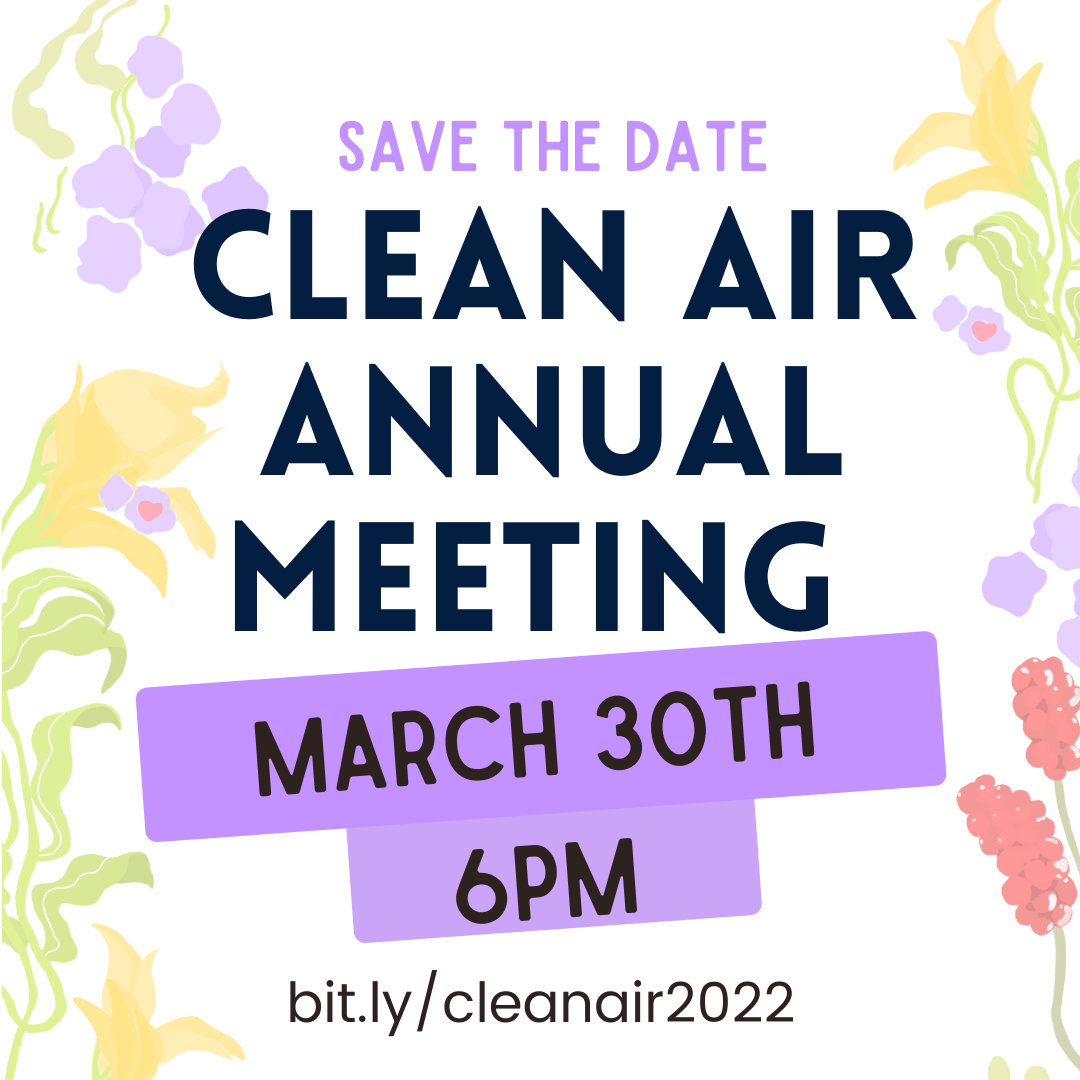
It’s that time of year! We’ll be holding our annual meeting on Wednesday, March 30th at 6pm on Zoom. Join us to hear about our work in 2021, our plans for 2022 and, if you’re a member, vote for our annual board of directors!
Register online today at bit.ly/cleanair2022
Members can vote for board candidates at bit.ly/3BvXZTJ
Not a member? Need to renew? No problem!
Renew your membership or join us as a first time member today! Check out our membership handbook below!